
CONTEXT
Oxford Street attracts 200 million annual visitors and 40,000 pedestrians per hour. This density creates opportunities for crime: London’s highest rates of theft from the person (e.g. pickpocketing, bag snatching, phone grabbing).


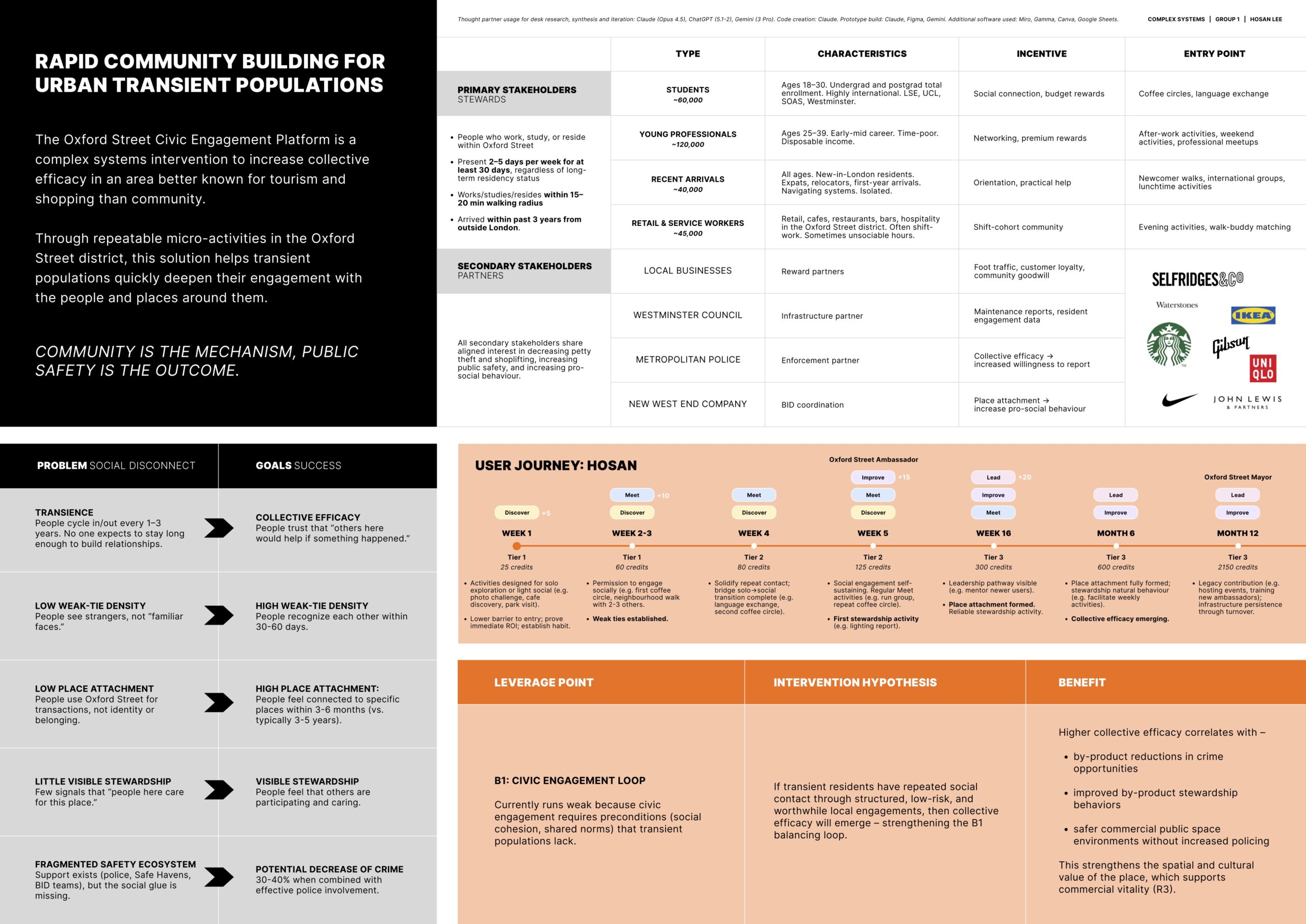
Collective efficacy – the shared expectation that neighbors will step in for the common good – is linked to 30-40% crime reduction.
Research shows safety comes from social connection. When people recognize neighbors and share expectations for mutual aid, crime decreases.
But Oxford Street’s resident population is young, international, and transient. Average stay: 1–3 years. 51% live alone. Shared norms and repeated contact are missing.
Can we create stewardship in an area that doesn’t traditionally have a community?
How might we create the conditions for collective efficacy rapidly, in a population that cycles every 1–3 years?
The Oxford Street Civic Engagement Platform quickly builds collective efficacy among transient populations.
Developed as part of the Complex Systems studio at the Royal College of Art to apply design futures methods to a live urban challenge.

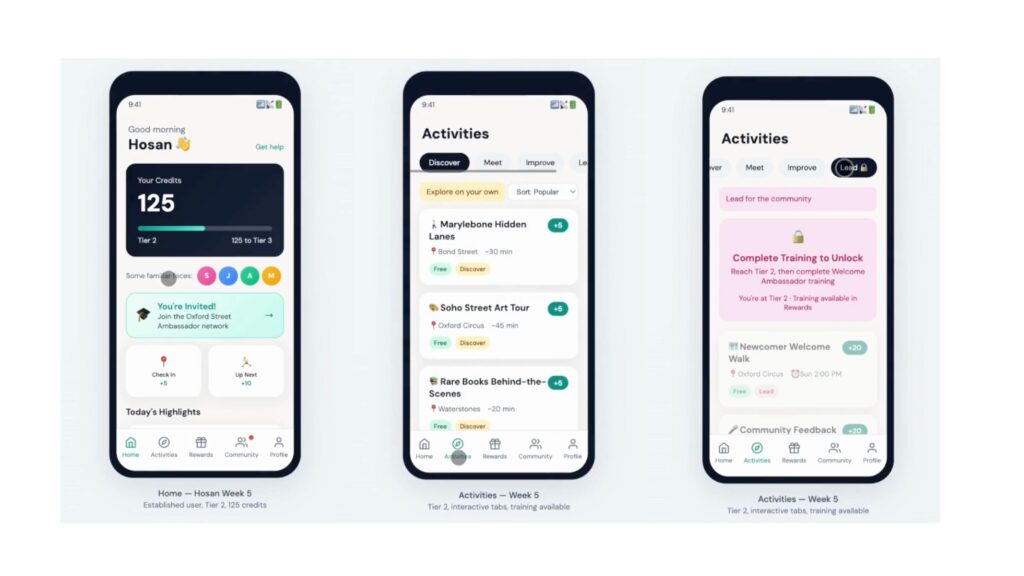
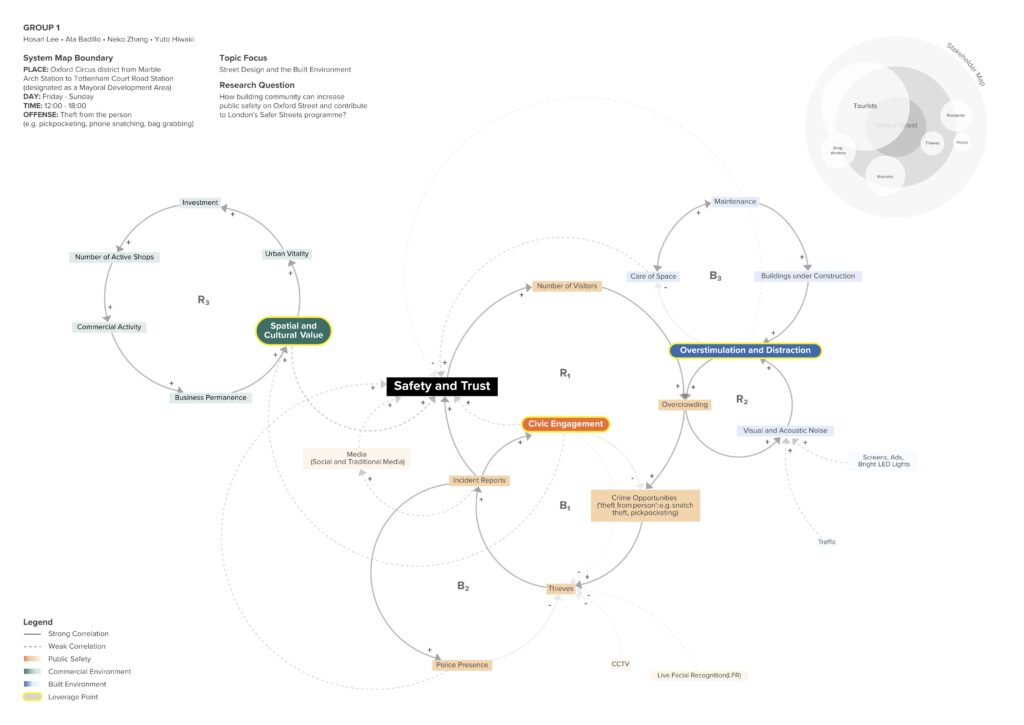
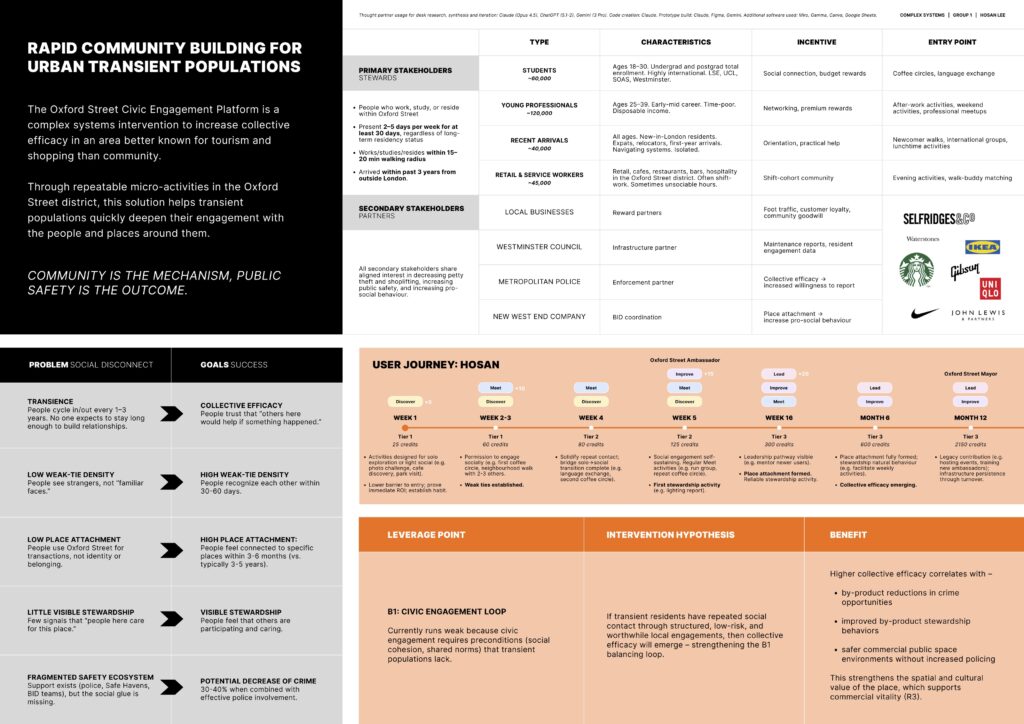
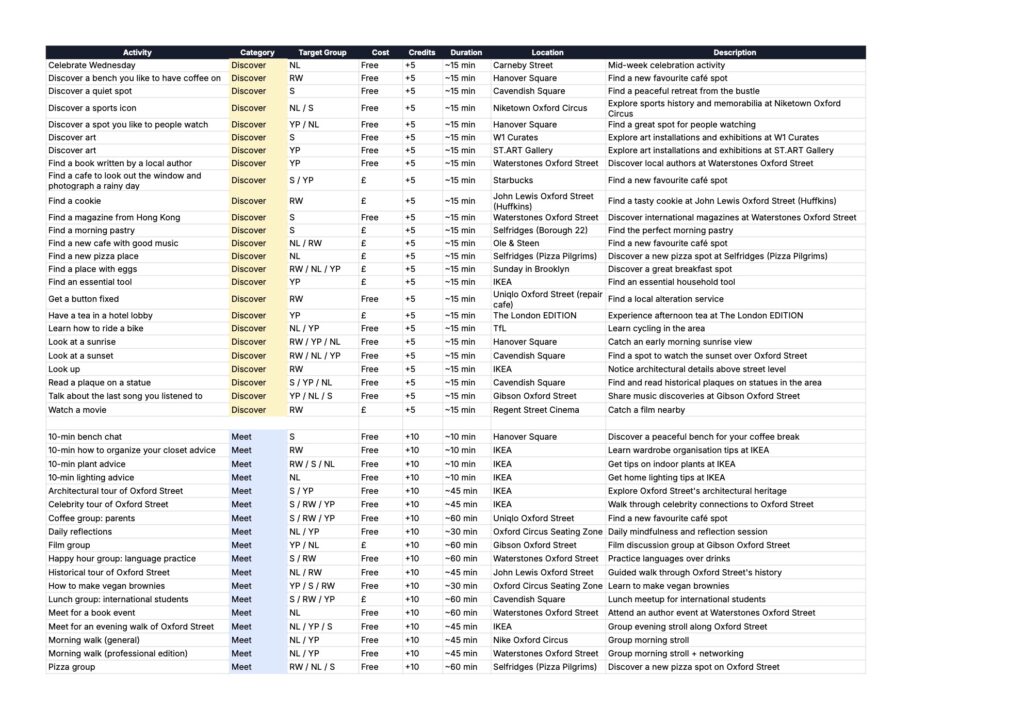

PROTOTYPE
67
ENGAGEMENT ACTIVITIES
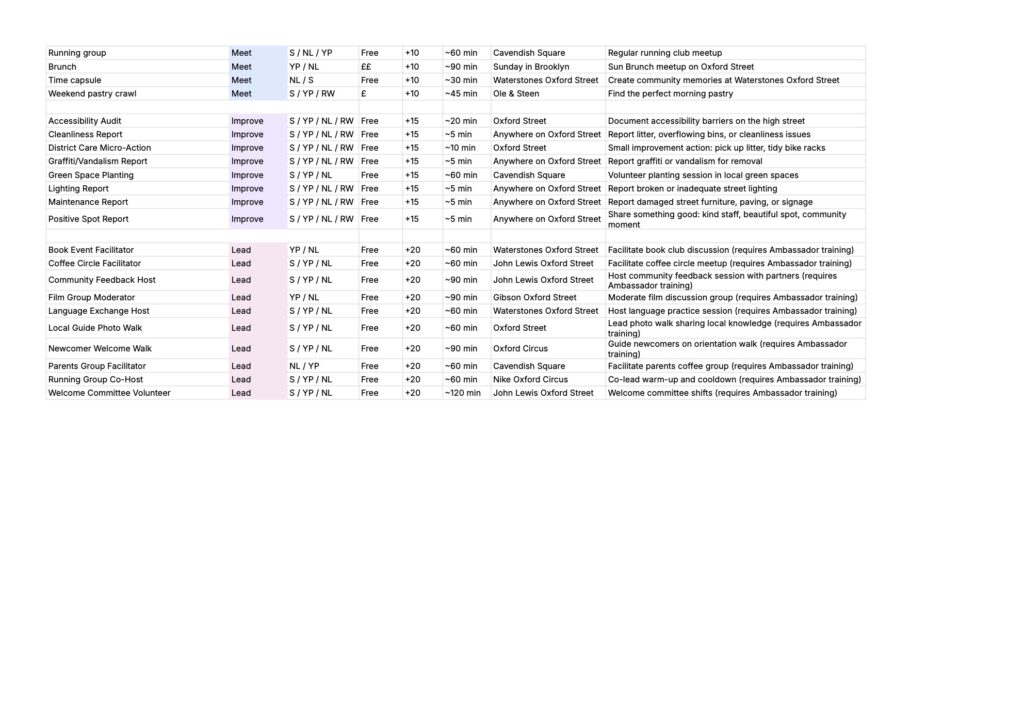
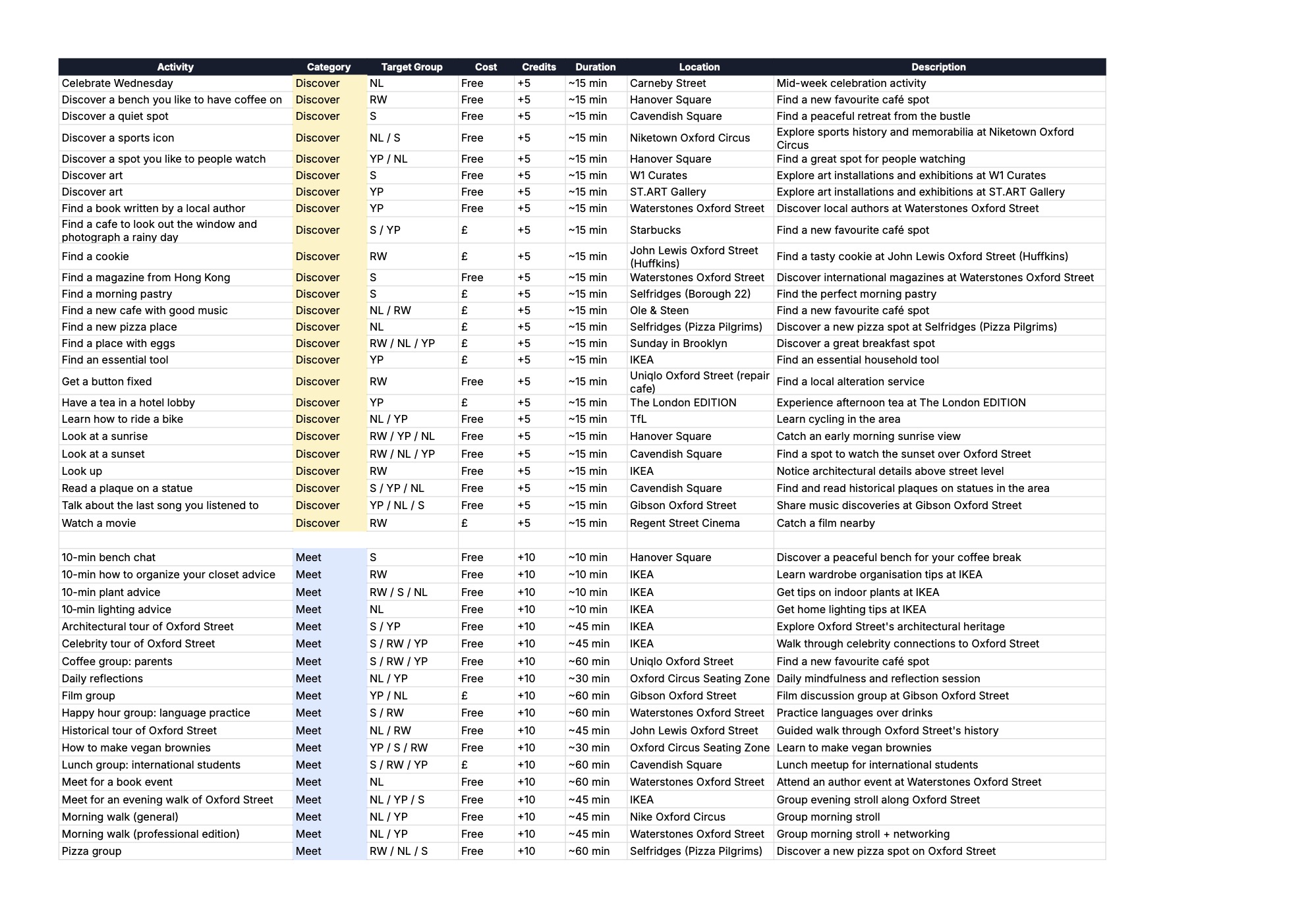
across four categories (Discover, Meet, Improve, Lead)
across four categories (Discover, Meet, Improve, Lead)
4
ITERATION CYCLES
documented assumption testing and pivots
documented assumption testing and pivots
5
wk
STRANGER TO STEWARD
rapid community building framework
rapid community building framework
Place attachment target: 3–6 months (versus the typical 3–5 years). Scalable framework transferable to other high-transience zones like Barcelona’s Ramblas or NYC’s Times Square.
interactive mobile prototype
Built with Claude, Figma, Gemini.
PROCESS
TOOL STACK
Research · Analysis · Writing · Synthesis
Claude • ChatGPT • Gemini • Perplexity
Design · Prototyping · Development
Figma • Claude • Gemini • Google Sheets
SIGNAL SCANNING
Domain
Signal
Opportunity
Social
Transient population of tourists, commuters, and workers. No residential anchor. Weak ties absent.
Design for rapid tie formation; don't assume existing relationships.
Technological
Opportunity for digital coordination. Existing apps remain fragmented and siloed.
Single platform to consolidate fragmented touchpoints
Economic
Retail decline underway. Mixed incentives among stakeholders create friction.
Align incentives through shared rewards system; retailers as partners not bystanders.
Environmental
Public realm quality varies. Few dedicated gathering spaces exist.
Activities don't require new infrastructure; use existing spaces differently.
Political
Westminster Council jurisdiction. Designated as a Mayoral Development Area to accelerate regeneration.
Policy momentum creates receptive environment for intervention pilots.
Values
Safety is a shared concern. Community is an aspiration, without mechanism.
Latent demand exists; provide the mechanism.
PROTOTYPE ITERATIONS
Iteration
Assumption Tested
Finding
Design Adjustment
v1
Environmental stewardship motivates engagement
Civic duty framing doesn't resonate with international transient populations
Pivoted to rewards-first model
v2
Crime reporting adds value
Creates liability, attracts wrong motivations, conflicts with community-building
Removed all reporting; Incident Support is recovery-only
v3
Activities are supplementary
Activity catalogue is central. Without structured contact, no weak ties form
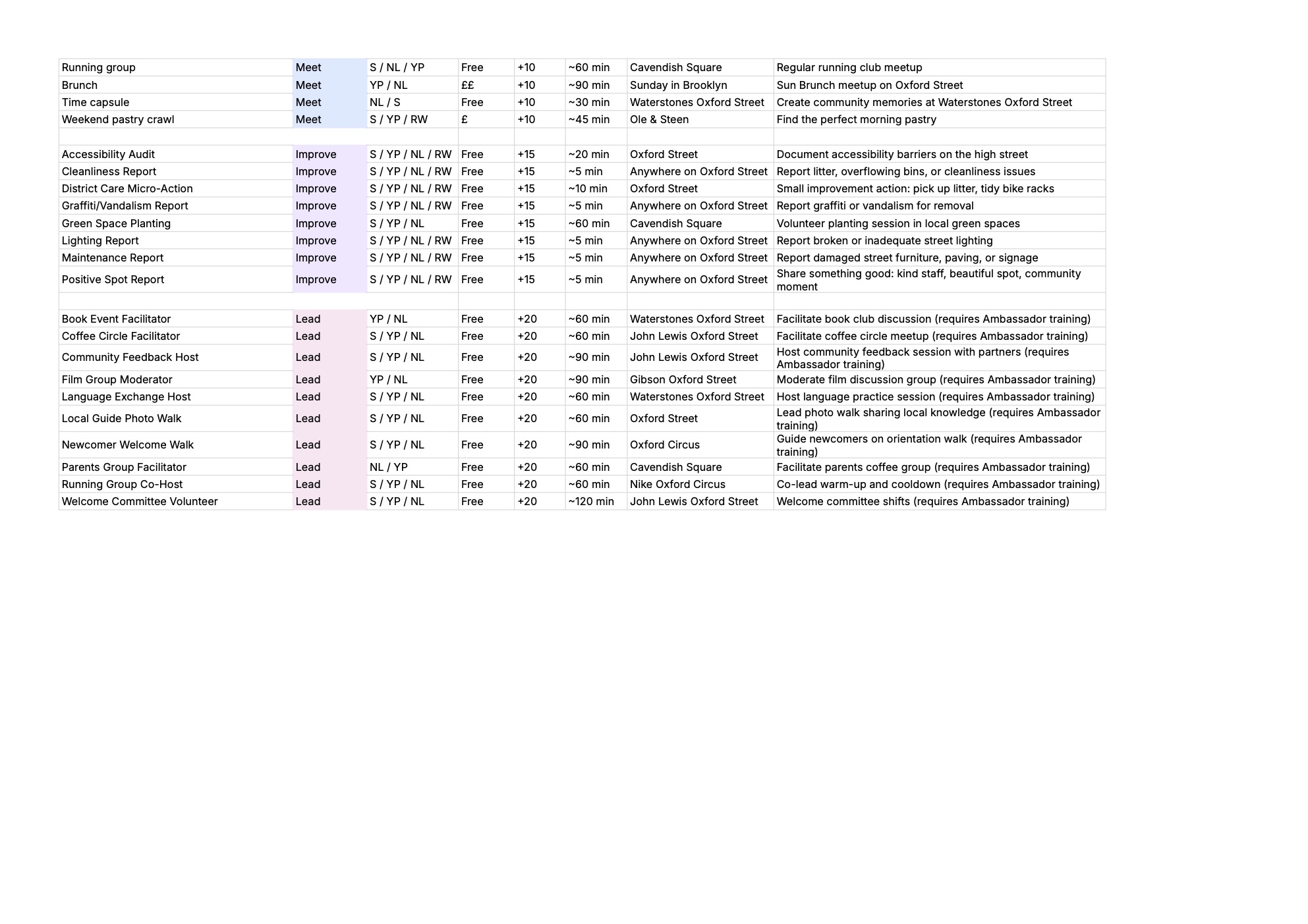
Expanded to 67 activities across four categories
v4
Single user type sufficient
Workers provide daytime coverage; residents provide evenings. Combined enables 24/7 efficacy.
Designed multiple-user type model
REFLECTION
Demonstrates methodology for designing interventions in environments where users lack existing social infrastructure. Directly applicable to aging contexts where isolation – due to mobility, relocation, and loss of existing networks – and unfamiliarity with products/services create adoption barriers.
The project applied TABLETRIBES methodology – designing structured conditions for strangers to form trust – to an urban systems context. The core challenge: how do you build social infrastructure where none exists?
Oxford Street added collective efficacy theory and evidence that community formation can be systematically accelerated even in populations that cycle every 1-3 years.
Open Questions
- How does collective efficacy build in genuinely transient populations vs. residential communities?
- What minimum “thickness” of social ties enables safety-oriented cooperation?
- How might the platform adapt to different urban typologies?
METHODS + SKILLS
Click to open
Research → Strategy → Action
Systems and strategy
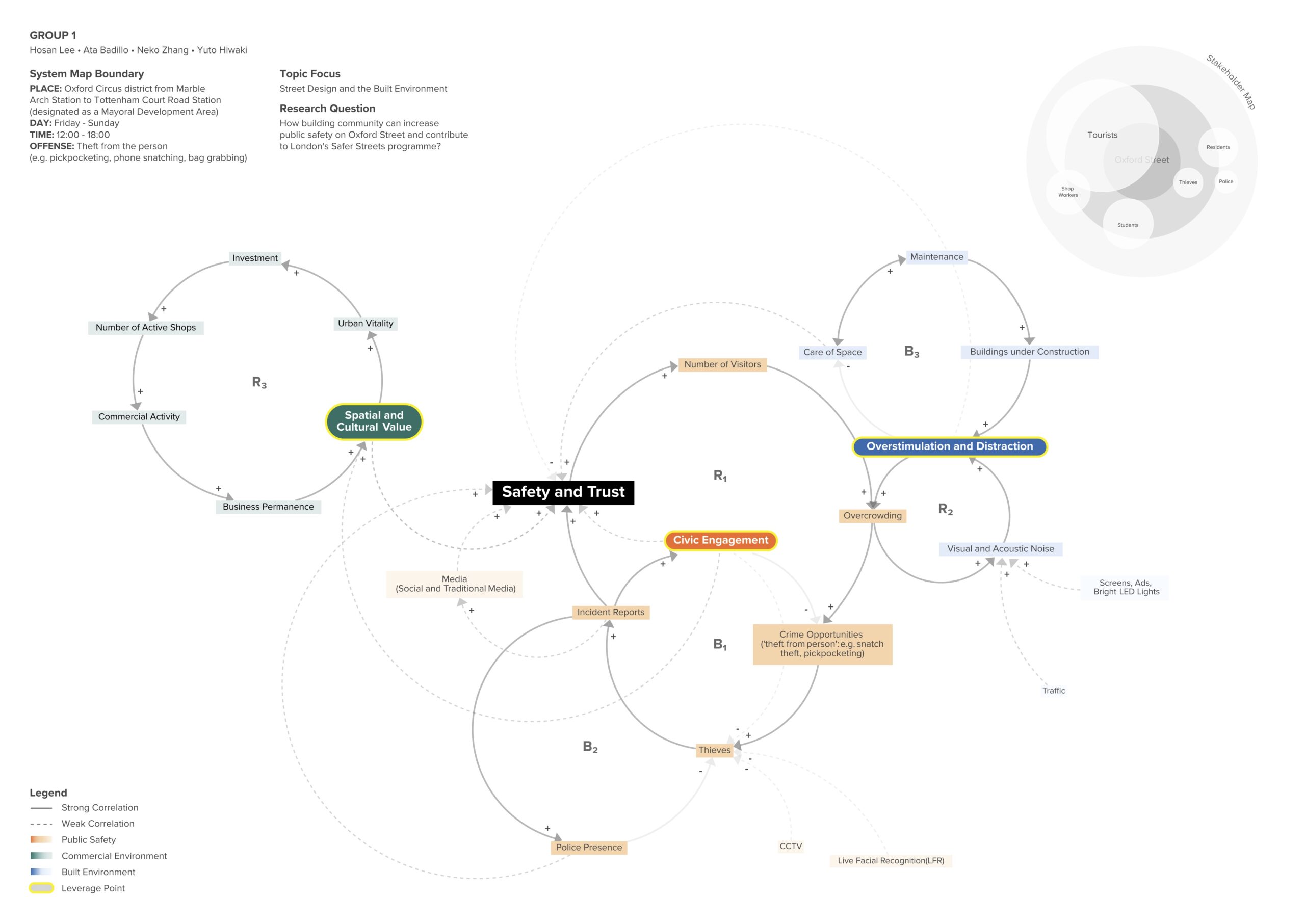
- Systems mapping and feedback loop identification
- Leverage point analysis
- Theory of change development
- Evidence-based intervention design
- Stakeholder coordination and user segmentation
Design and prototyping
- Design-based prototyping with documented iteration cycles (v1–v4)
- Community and engagement design
- Activity and progression system design (67 activities, credit-based tiers)
- Mobile app UX/UI design
- User journey design and behavioral onboarding
Research and validation
- Site ethnography
- Stakeholder validation surveys
- Service design
SOURCES
Click to open
- Cozens, P. and Love, T. (2015) ‘A Review and Current Status of Crime Prevention through Environmental Design (CPTED)’, Journal of Planning Literature, 30(4), pp. 393-412.
- Granovetter, M. (1973) ‘The Strength of Weak Ties’, American Journal of Sociology, 78(6), pp. 1360-1380.
- Home Office (2023) Crime outcomes in England and Wales 2022 to 2023. London: Home Office.
- Lewicka, M. (2011) ‘Place attachment: How far have we come in the last 40 years?’, Journal of Environmental Psychology, 31(3), pp. 207-230.
- New West End Company (2024) Oxford Street: 2030. London: New West End Company.
- Sampson, R.J. (2012) Great American City: Chicago and the Enduring Neighborhood Effect. Chicago: University of Chicago Press.
- Sampson, R.J., Raudenbush, S.W. and Earls, F. (1997) ‘Neighborhoods and Violent Crime: A Multilevel Study of Collective Efficacy’, Science, 277(5328), pp. 918-924.
- Yesberg, J.A. and Bradford, B. (2021) ‘Policing and collective efficacy: A rapid evidence assessment’, International Journal of Police Science and Management, 23(4), pp. 417-430.