RCA DESIGN FUTURES MASTERS THESIS
Age with Agency: Building a pro-ageing consumer product ecosystem by 2050

CONTEXT
People over 60 – regardless of what country they’re in – are actively rejecting products that frame ageing as decline, while the consumer products they actually need and want don’t exist. The knowledge base around ageing is extensive, and decades of research have mapped what older adults are demanding and requesting. Almost none of it reaches the products.
One in six people globally will be over 60 by 2030. By 2050, this number is 2.1 billion people. According to AARP, adults aged 50 and over in the US already generate $12.5 trillion in economic activity, 43% of GDP. We are witnessing a generation of older adults who are more self-directed than any before, running into systems that were designed for a population assumed to be passive and in the minority.
This is not a niche group. Every generation reaches this point in the sequence of life. The Boomer generation is moving through this stage right now. Gen X has just started, and around the corner are Millennials. We have a narrow window to shape the social and physical infrastructure of a new intergenerational reality, and the products people will want inside it.
Currently in progress as an independent research project for the RCA Design Futures masters programme, alongside a guest researcher position at the Helen Hamlyn Centre for Design.

INDEPENDENT RESEARCH PROJECT
What does it look and feel like to live within a pro-ageing consumer landscape in 2050?
This project asks what a coordinated ecosystem approach towards a pro-ageing 2050 would require. Its central move pairs diagnosis with futures methods. The Ageing Market Diagnostic locates where products fail older consumers along the value chain, and worldbuilding constructs a 2050 tangible and shareable enough to coordinate around. The same instrument specifies both ends, failing present and preferable future, so the route between them can be backcast.
That future centres on the practice of entrepreneurship as worldbuilding, told through a first-person autoethnographic day-in-the-life of me at 73 as the founder of a speculative consumer brand called BOLD. In this future, I create products and environments inclusive of older people’s needs across four domains: home, work, play, and life. It is built to give companies, investors, and knowledge and advocacy bodies who could close the gap a shared vision to move towards together: a later life that is joyful, meaningful, actively engaging, iterative, and socially interactive.
In 2026, aging remains understood through deficit, discrimination, stigma, medicalization, and decline – rather than possibility, opportunity, and celebrated learnings.
But longer lives and higher standards demand new products, services, and ways for people to connect that don’t yet exist.
I envision a future in 2050 where older people are empowered with the agency to define their own identity and wellbeing without shame or stigma. They are perceived as valued members of society, and actively contribute to building the world around them.
116 million people aged 65+ across eight countries with varied policy approaches, market structures, and cultural attitudes
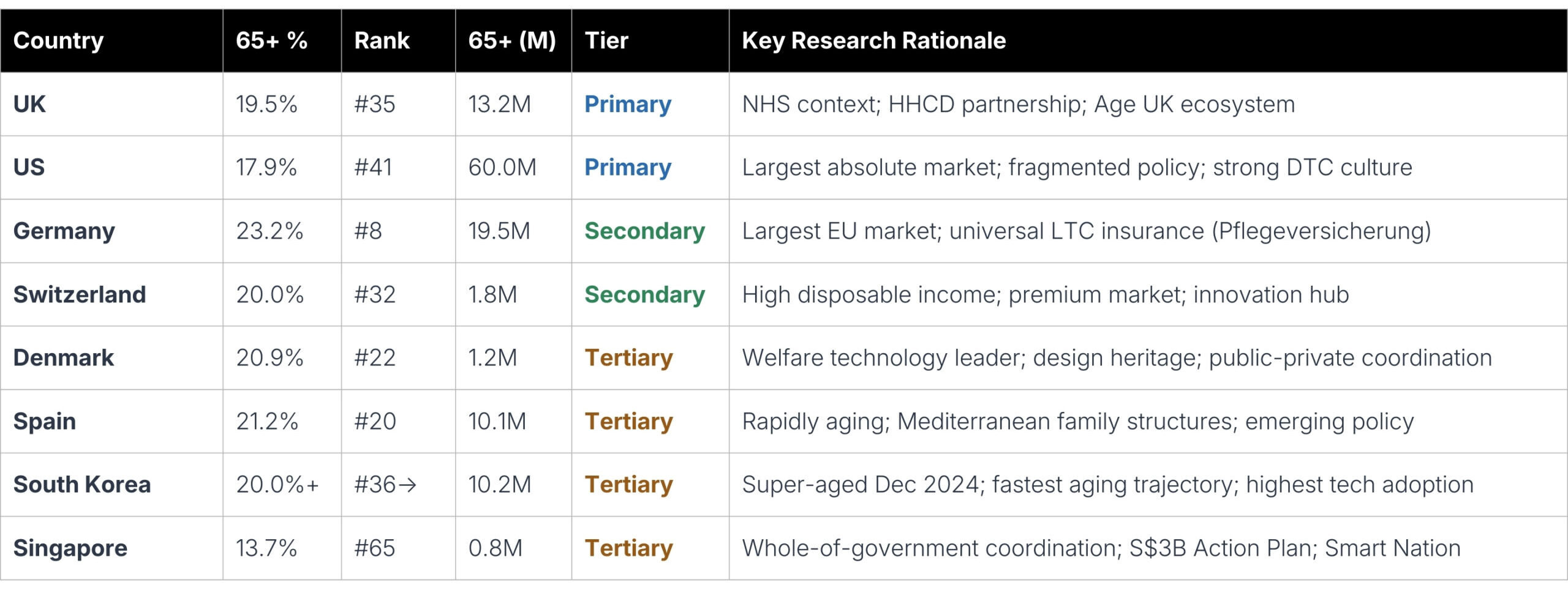
Data: UN World Population Prospects 2024; TheGlobalEconomy.com
The 50+ population accounts for $35 trillion in global consumer spending – half the world total. Those over 65 are the biggest spenders within that group, but consistently underserved.
The system fails in two directions:
- Products designed for later life are rejected by those who need them
- Products actually needed by older adults often don’t exist
This research uses futures methods to identify where the system can be redirected toward better outcomes by 2050.
Technology adoption, consumer psychology, and gerontology focuses on functional barriers – cost, access, usability – while under-exploring the psychological, emotional, and cultural factors that may be more determinative.
Across all STEEP dimensions and all regions studied, one pattern emerges: people resist products that position them as “old.” This is not just a psychological barrier at the individual level. Interventions must address identity at system level, not just product level.
These adoption barriers of identity, stigma, and framing over functionality will likely replicate as AI-powered products reach aging populations, making this research relevant beyond traditional product categories.
Ground – primary field research (2022–2025, pre-RCA)
This is the grounding the RCA thesis project was built on, and the source of the identity-based user rejection finding.
- Qualitative interviews. Older adults, physicians and caregivers on experience, worldview and product choice. US and Switzerland.
- Observational fieldwork. Older adults navigating urban life in Zurich, Munich, and Copenhagen.
- Longitudinal product observation. Early tracking of ageing household categories: what reaches the market, how it enters homes, how it is used, and how it is adopted or refused.
- Open literature scanning. Ageing, gerontology, design, retail, consumer psychology and policy, read before any framework existed to sort it into.
- Initial product landscape and stakeholder mapping. A first map of the ageing product and service system.
Diagnose – reading why a system holds
- Causal-loop mapping. Five feedback loops holding a market failure in place, built as an interactive artefact.
- Leverage-point analysis. Identified where intervention could change behaviour and shift the system.
- Value-chain analysis. Adapted Porter’s six stages to locate where failure originates rather than where it shows up, applied across several products and several kinds of organisation.
- Evolved ecosystem and stakeholder mapping. Placed actors against the value-chain stage they can influence in primary and secondary tiers, with investment mapped as a separate layer.
- Diagnostic instrument design. Designed an original framework of three alignment conditions, three gap types and six value-chain stages. Built an interactive input tool and output page: enter a product and it returns where the failure sits, how severe it is, and how urgent. Every diagnosis is stored, so cases accumulate into a comparable set.
- Historical cultural coding. An object’s meaning traced from 1700 to the present, with a Jobs-to-be-Done layer asking what the object was bought for in each era: e.g. status, style, medical necessity.
- Critical source appraisal. An annotated review of 23 literature and practice sources selected for what they added or for changing my position.
- Research knowledge architecture. Built a 461-page structured vault with live query dashboard over the top.
Scan – reading where a system is going
- Horizon scanning. Continuous collection across eight target markets, tiered by research priority, structured on STEEP/PESTLE domains and layered on Sharpe’s Three Horizons.
- Macro foresight synthesis. STEEP/PESTLE by Three Horizons grid, built from institutional foresight and policy reporting on global megatrends, outside the subject literature. Set the drivers for the 2050 worldbuilding.
- Signal infrastructure design. A two-layer database of 88 macro and 496 micro signals.
Envision – making a preferable future tangible
- Speculative worldbuilding. A documented set of rules for the 2050 world, holding both systems and the lived experience in all decision-making.
- Autoethnography. A first-person day-in-the-life carrying entrepreneurship itself as the worldbuilding practice, with my decisions as the mechanism the world is built through.
- Diegetic prototyping. The BOLD product family built as artefacts from inside the world, each one a diagnosed gap closed, with a features dossier and a catalogue-from-the-future format.
- Speculative image production. Speculative visualisation of the 2050 world across global forces, domains, and products.
Coordinate – moving actors together
- Strategic backcasting. The route from the 2050 world back to the present, traced through the same diagnostic that identified the failures. Each gap closed in the future has a present-day action attached.
- Theory of change. A map of how the system could move: five routes from where it is now to where it needs to be, each with the action required, who has to take it, and what has to hold true. Four of the five routes are structural and one works through culture.
SIGNALS
The following signal categories frame how aging populations interact with products, services, and identity. Adoption fails when these three don’t align, and the gap between them is where opportunity sits. This small set of examples collectively represent almost $80B in current global value across categories where older adults are the primary or fastest-growing consumer segment, yet remain systematically underserved by existing product design.
1. Behavioral signals
WHAT PEOPLE DO
Older adults are already solving their own problems. Products that align with this agency get adopted; products that impose decline framing get rejected.
Walking sticks + canes (Global)
$3B
Potential Market Value
Mordor Intelligence (2025). Walking Assist Devices Market Size. / Allied Market Research (2024). Trekking Poles Market Size.
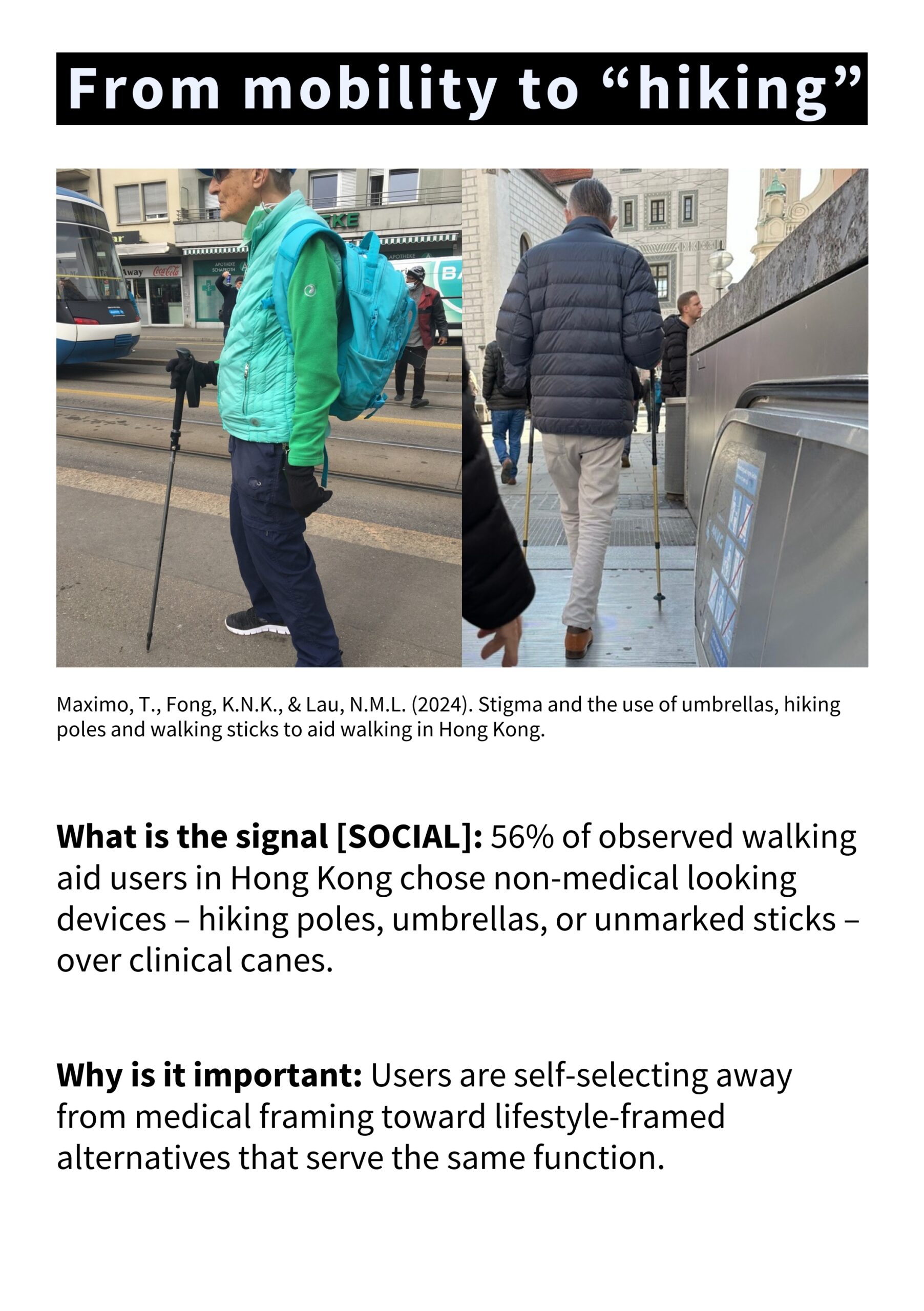
People who reject medical canes (signals decline) are buying hiking poles (signals vitality) instead, a self-directed workaround that the market hasn’t named. The same need (stability, fall prevention, confidence) is served by two entirely separate value chains: canes flow through medical supply and healthcare channels; hiking poles flow through outdoor retail.
Opportunity: Reframe
50+ gaming (Global)
$5B
Potential Market Value
AARP Research (2023). The 50-Plus Gamer of Today and Tomorrow. Washington, DC: AARP Research.
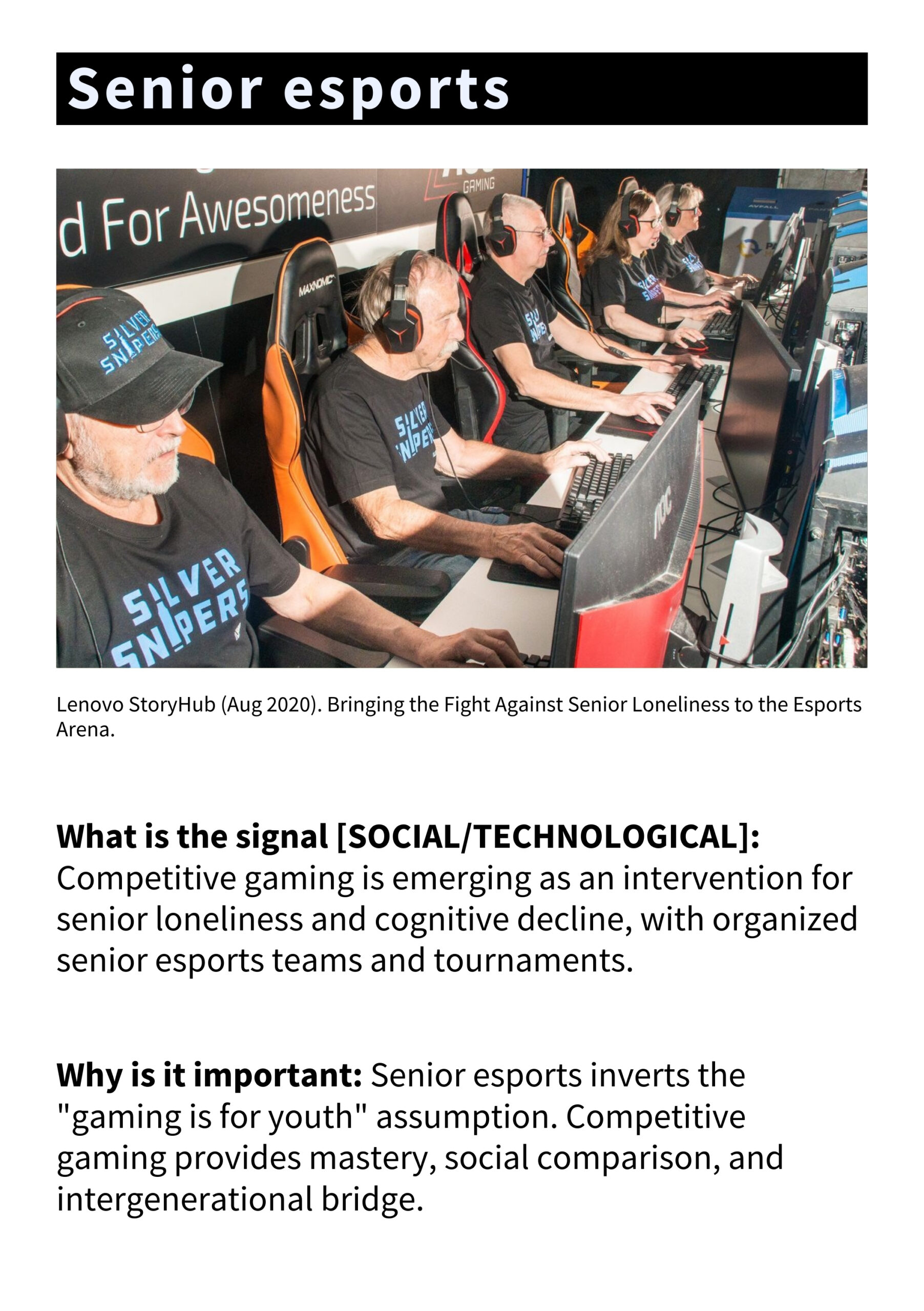
The fastest-growing gaming demographic worldwide is over 50. In the U.S. alone, 52 million are active gamers – and 69% say games aren’t designed for them. A $189B global industry with almost no products built for its most underserved segment.
Opportunity: White space –> build new
2. Cultural signals
WHAT CULTURE PERMITS
Cultural validation is ahead of product markets. Mainstream media and entertainment already frame aging as vitality, autonomy, and style, and yet the products available still signal decline. The gap between cultural framing and product framing is where the opportunity sits.
55+ Influencer Marketing (Global)
$8B
Potential Market Value
McKinsey & Company / The Business of Fashion (2025). The State of Fashion 2025.
People 55+ control the majority of household wealth in most developed economies, yet only 3% feel seen by brands. A $3-8B opportunity in a global $33B industry where the highest-value consumers are the least served.
Opportunity: White space –> build new
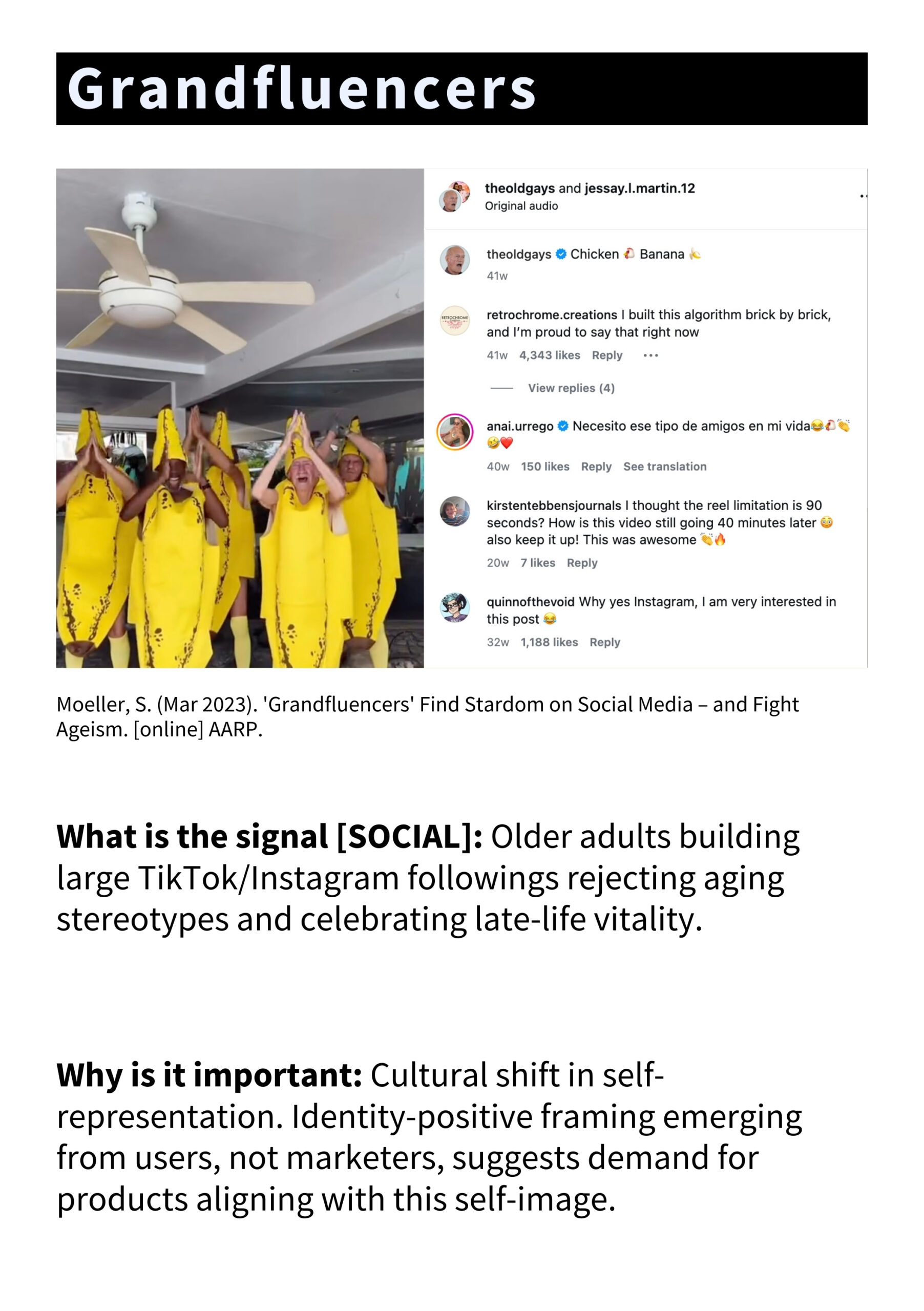
65+ OTC pain relief (Global)
$10B
Potential Market Value
Mordor Intelligence (2026). Over-the-Counter Analgesics Market – Size, Share & Industry Analysis.
Older adults are the heaviest users of OTC pain relief globally. Rising healthcare costs are accelerating openness to alternative treatments – from topicals to CBD and cannabis – but product design hasn’t caught up with the clinical reality of aging bodies.
Opportunity: Redesign –> culture is ahead of product
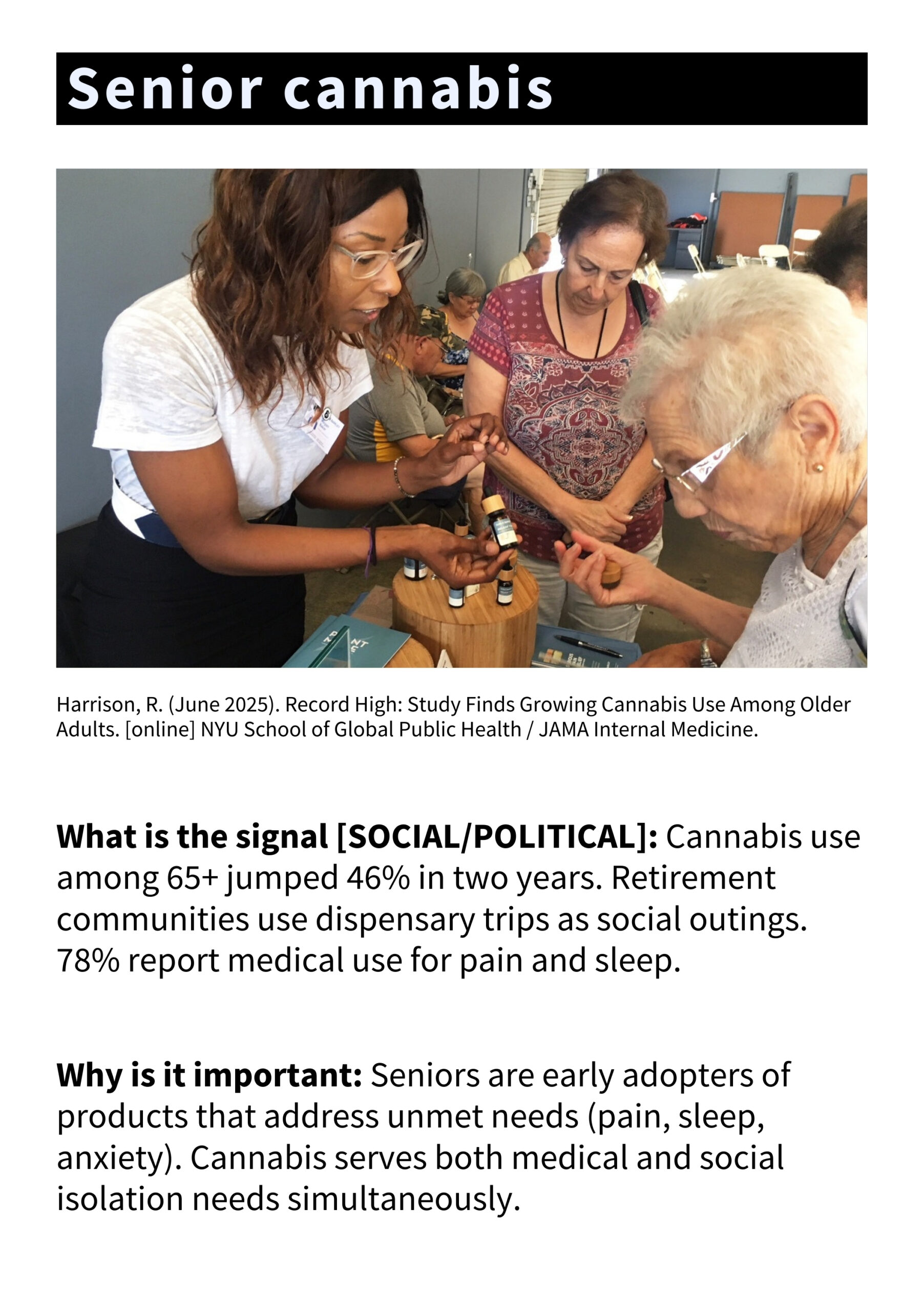
EVIDENCE OF CULTURAL PERMISSION

Vogue Philippines [SOCIAL/VALUES]: Vogue Philippines’ April 2023 cover featured older women, positioning aging beauty alongside mainstream fashion. That this came from an Asian edition, not a Western one, signals a global cultural shift in how aging is represented. When a cultural institution that defines aspiration includes older faces, it signals that the market’s age-segregated framing is outdated.
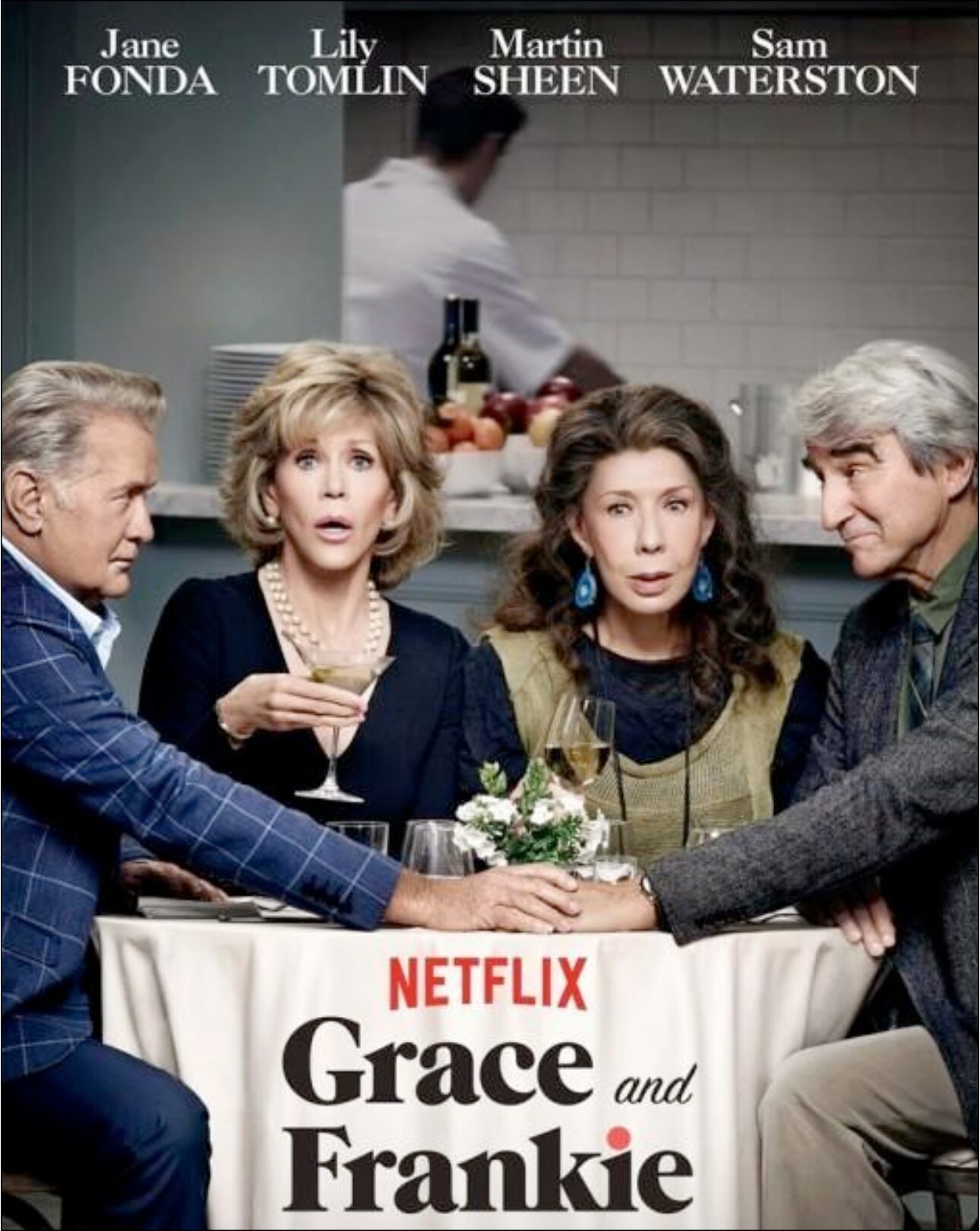
Grace and Frankie [SOCIAL/VALUES]: Netflix’s longest-running original series at the time centered two women in their 70s navigating divorce, entrepreneurship, sexuality, and friendship. The show normalised late-life reinvention as entertainment – not special interest – reaching mainstream audiences who don’t self-identify as “aging content” consumers.
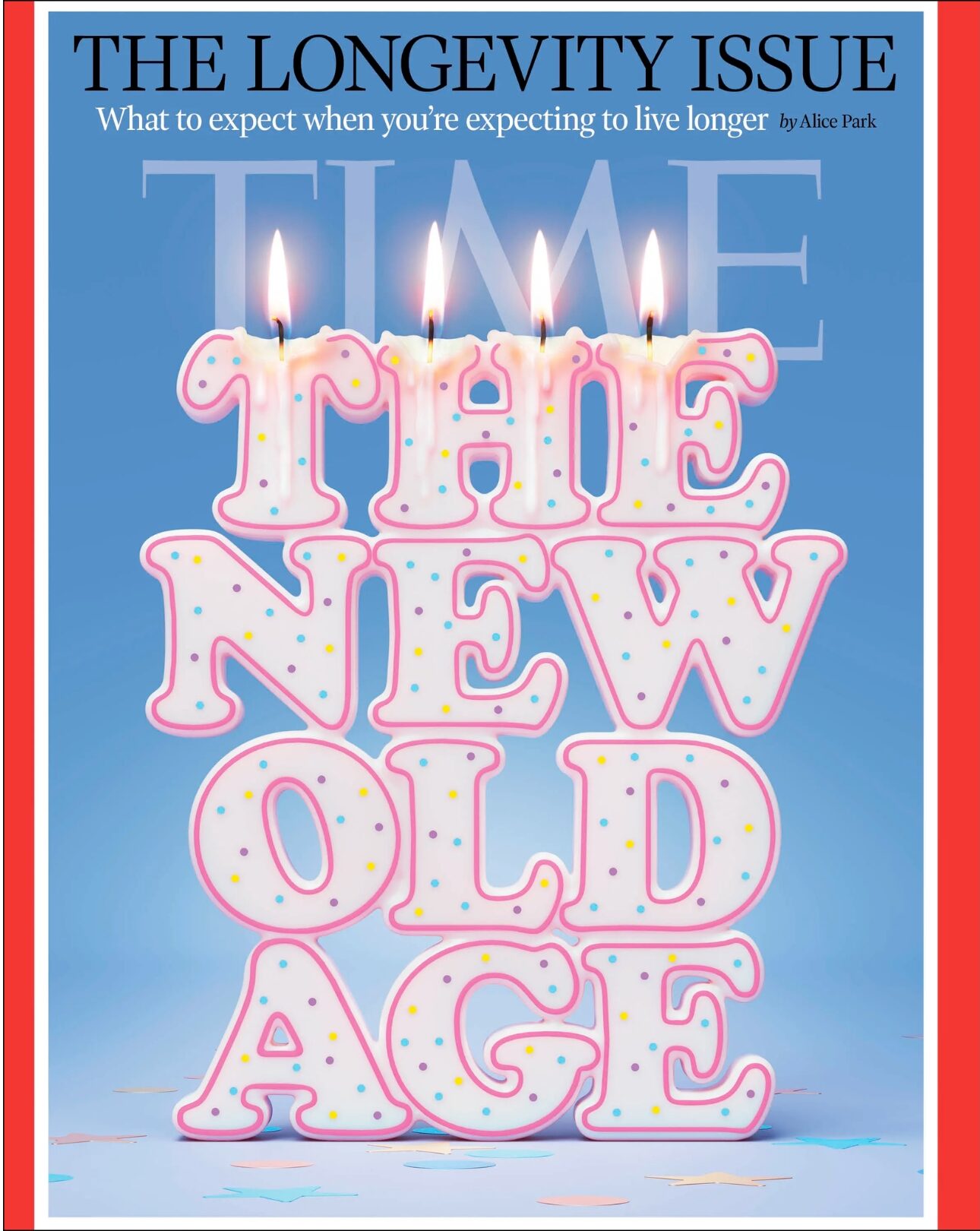
Time “The New Old Age” [SOCIAL/VALUES]: Time magazine’s January 2026 cover framed longevity as the defining demographic story of the era, positioning aging not as a medical problem but as a societal transformation. When media reframes aging from healthcare burden to economic and cultural opportunity, it reshapes the context in which products are developed and received.
3. Product signals
WHAT SYSTEMS DELIVER
Adoption is shaped by the system around the product – regulation, framing, distribution – not just the product itself.
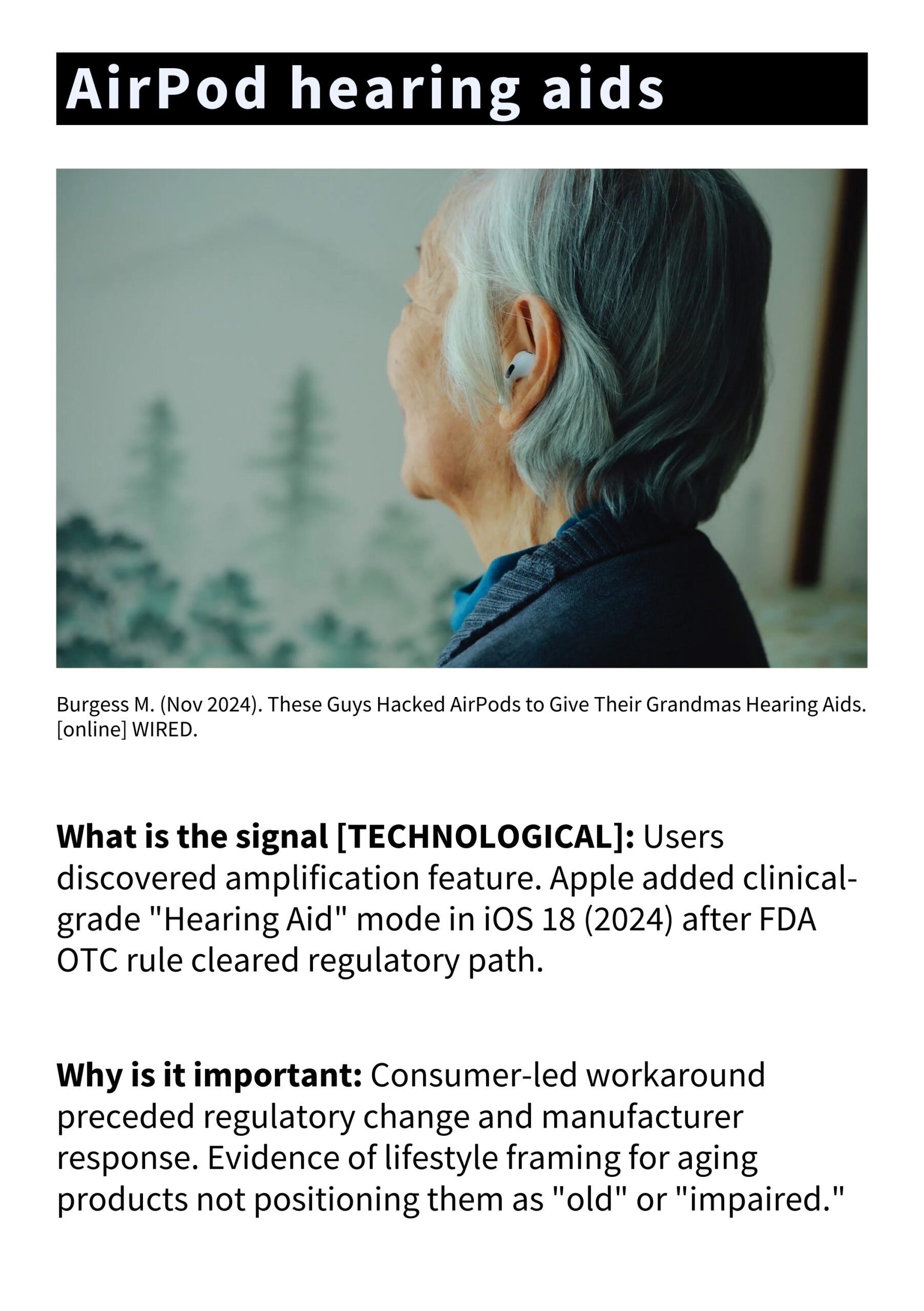
hearing aids (Global)
$20B
Potential Market Value
MarkeTrak 2025 / Hearing Industries Association. Hearing Aid Adoption in the OTC Hearing Aid Era.
The WHO estimates over 1.5 billion people globally live with some degree of hearing loss, yet adoption of hearing aids remains low worldwide. Across markets, systemic issues – product design, regulation, framing, distribution – still signal “medical device,” not lifestyle.
Opportunity: Reframe
aging-in-place + accessibility (global)
$27B
Potential Market Value
Stratistics MRC (2025). Aging-in-Place and Home Accessibility Solutions Market Forecasts to 2032.
Across developed economies, the vast majority of older adults prefer to remain in their homes – yet most don’t anticipate needing modifications until a crisis forces it. That perception gap is the design problem.
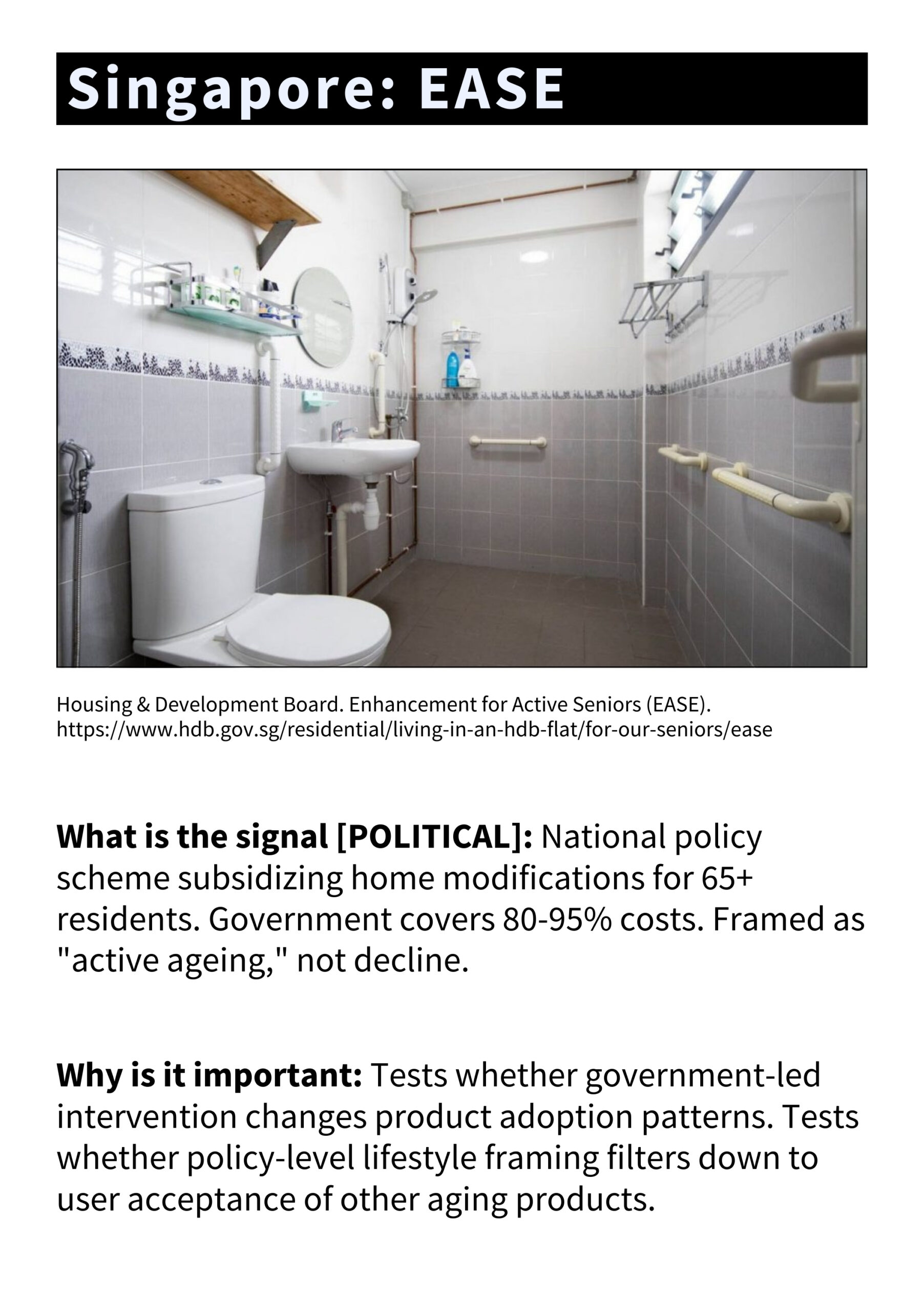
Opportunity: Redesign –> shift function from crisis response to proactive adoption)