
CONTEXT
The “loneliness epidemic” entered U.S. mainstream discourse in 2017. But in 2011, social disconnection was already an everyday experience – an overlooked problem that preceded acknowledgment by years.
Mental health services addressed symptoms. Community programs addressed access. Neither designed for how people actually form trust and connection.
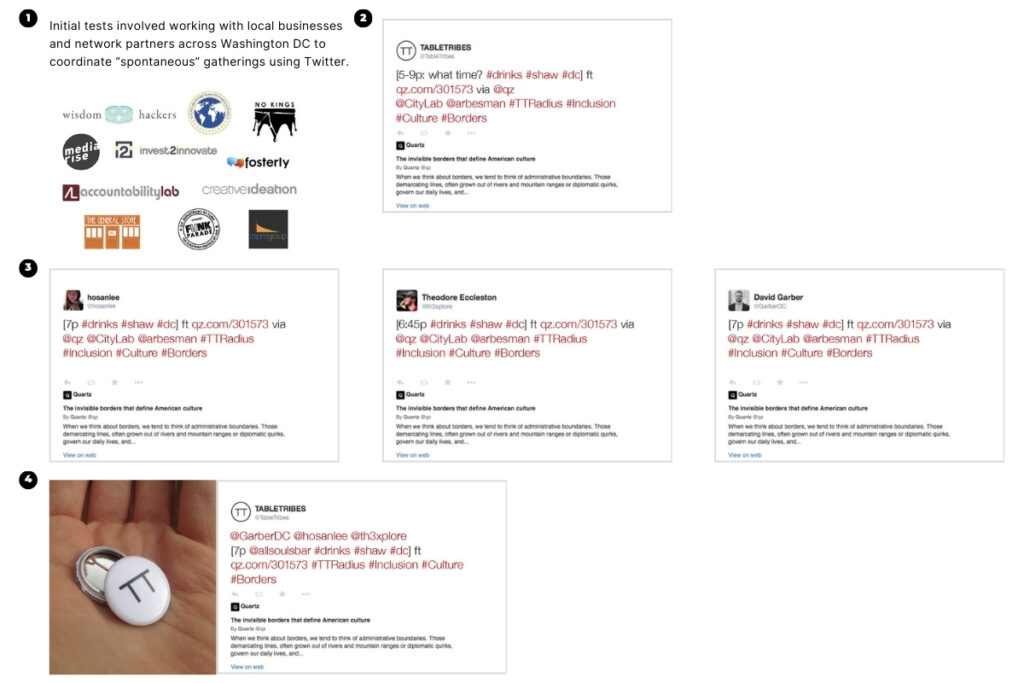
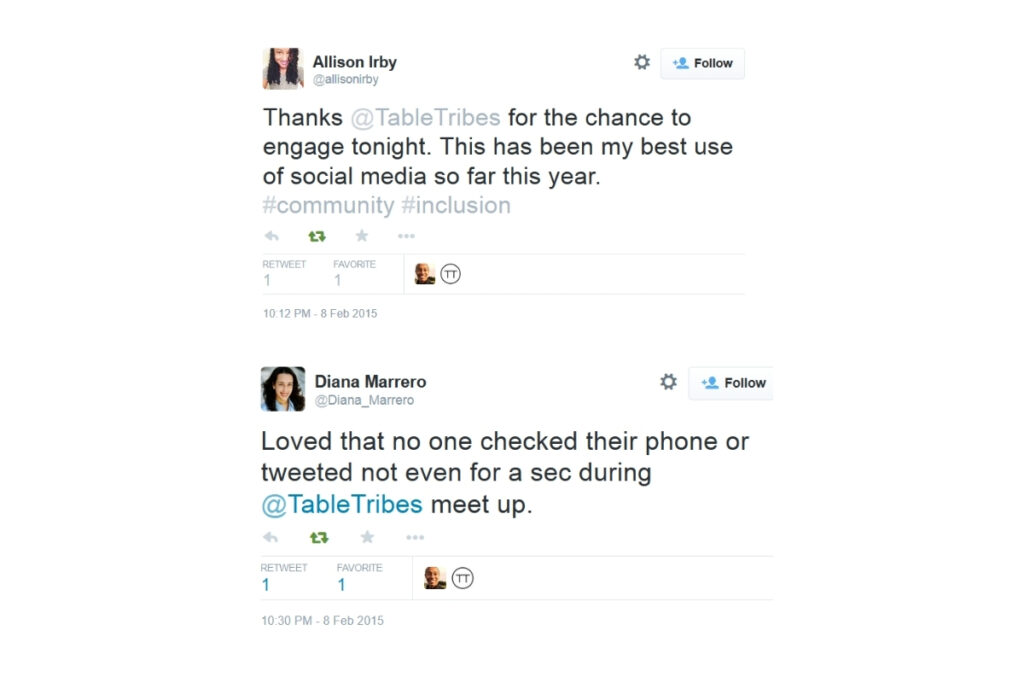
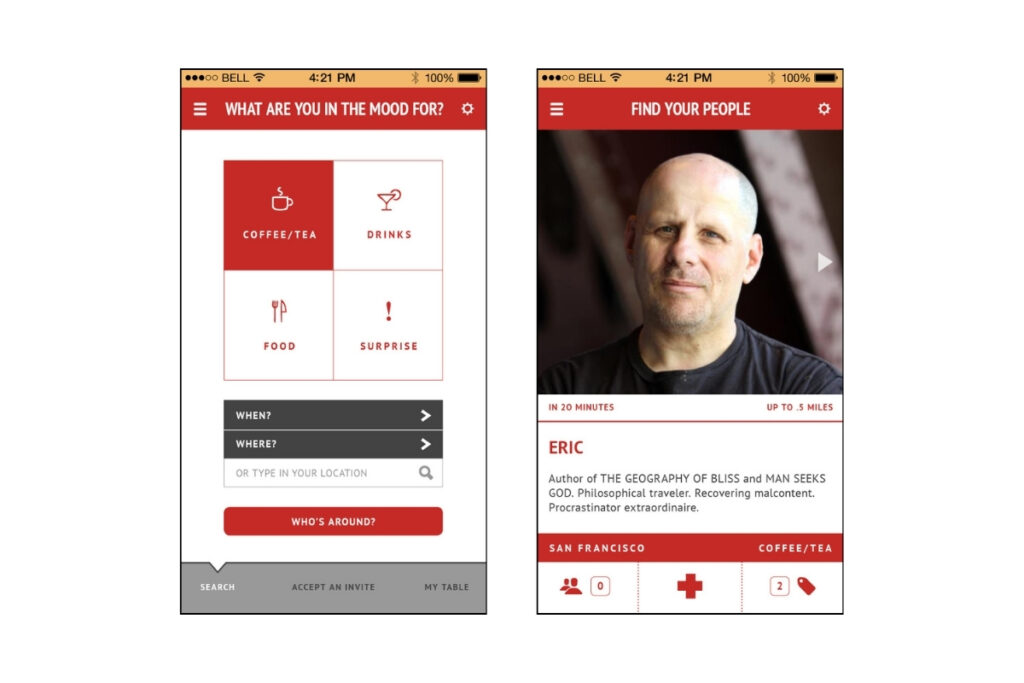
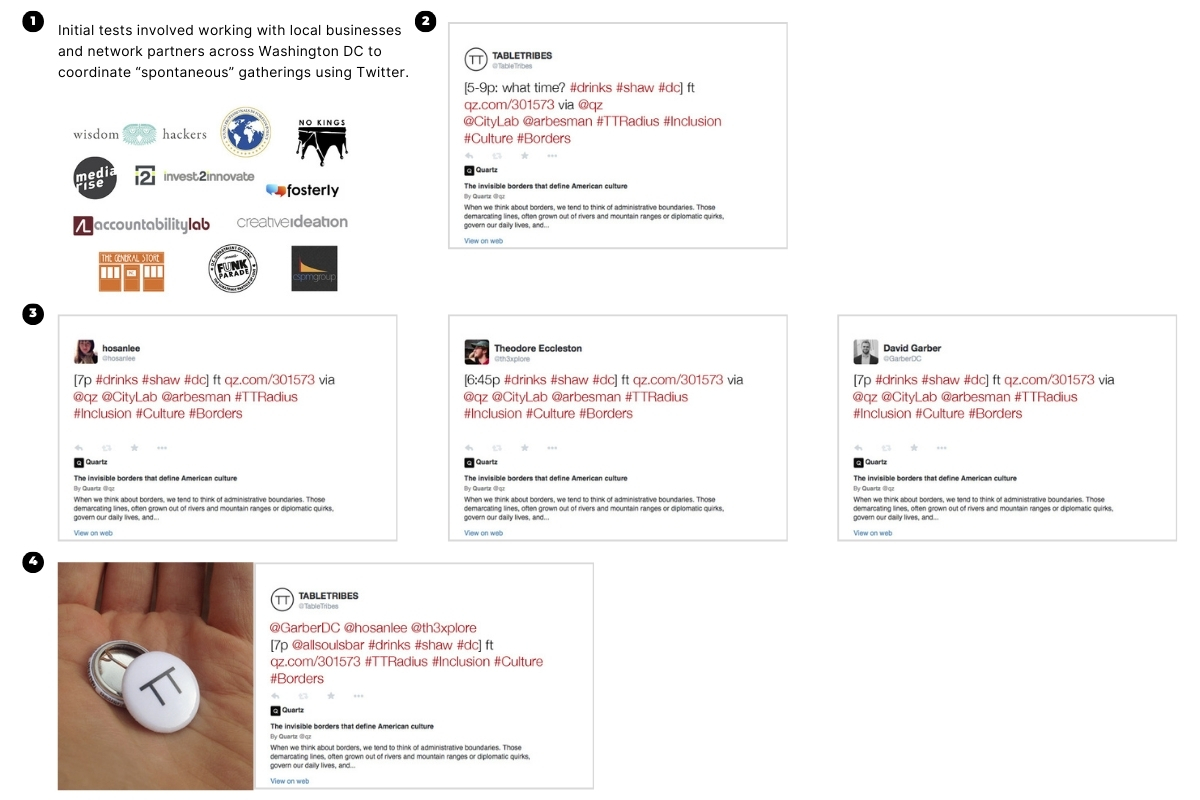
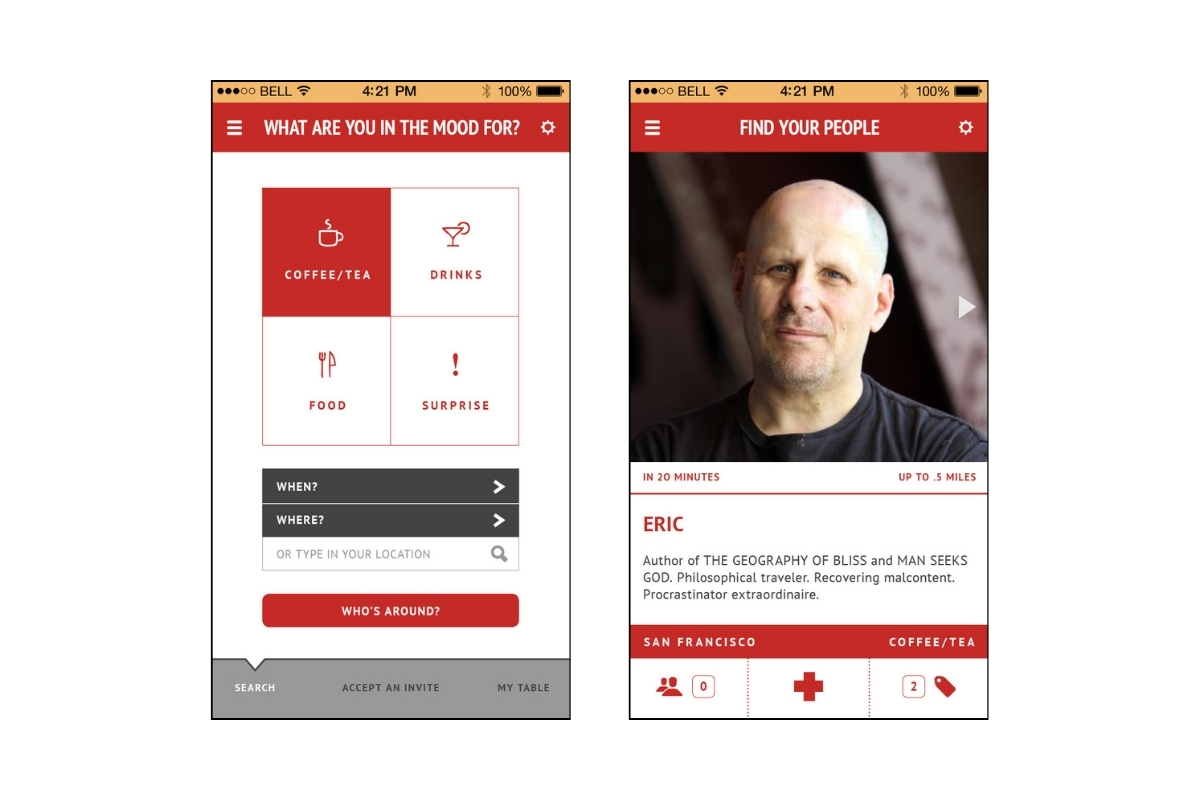
TABLETRIBES was a six-year startup that began with live event prototyping, translated insights into a mobile product, and developed a repeatable playbook for conversation design and facilitation at scale.
3
K+
USERS REACHED
across five cities
across five cities
100
+
FORMAT ITERATIONS
rapid prototyping cycles
rapid prototyping cycles
6
YEARS OF OPERATION
2012–2018
2012–2018
5
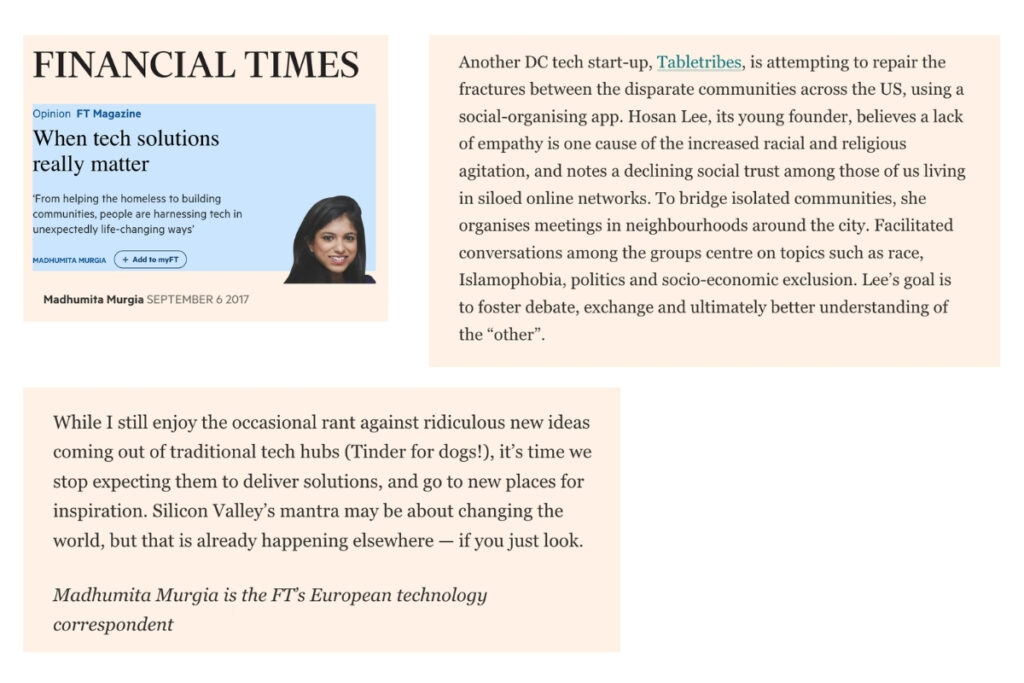
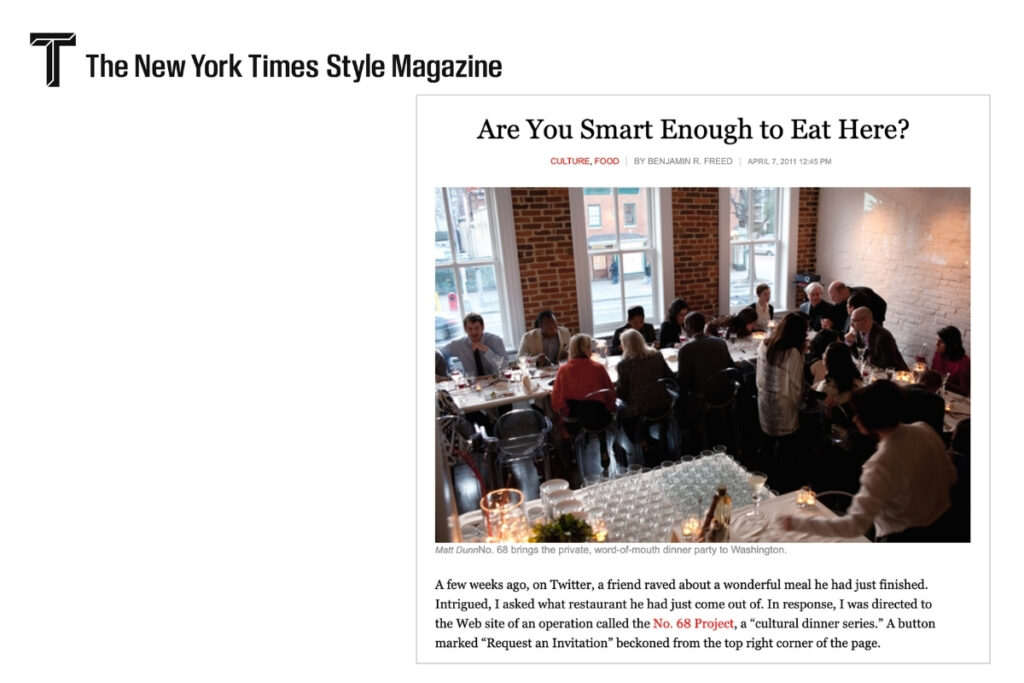
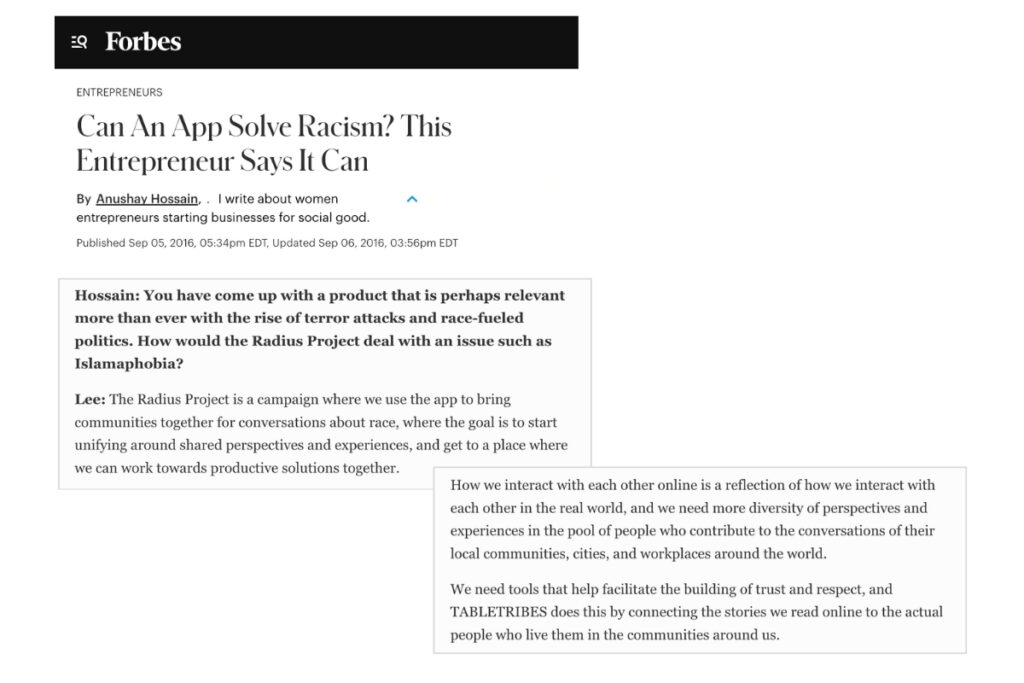
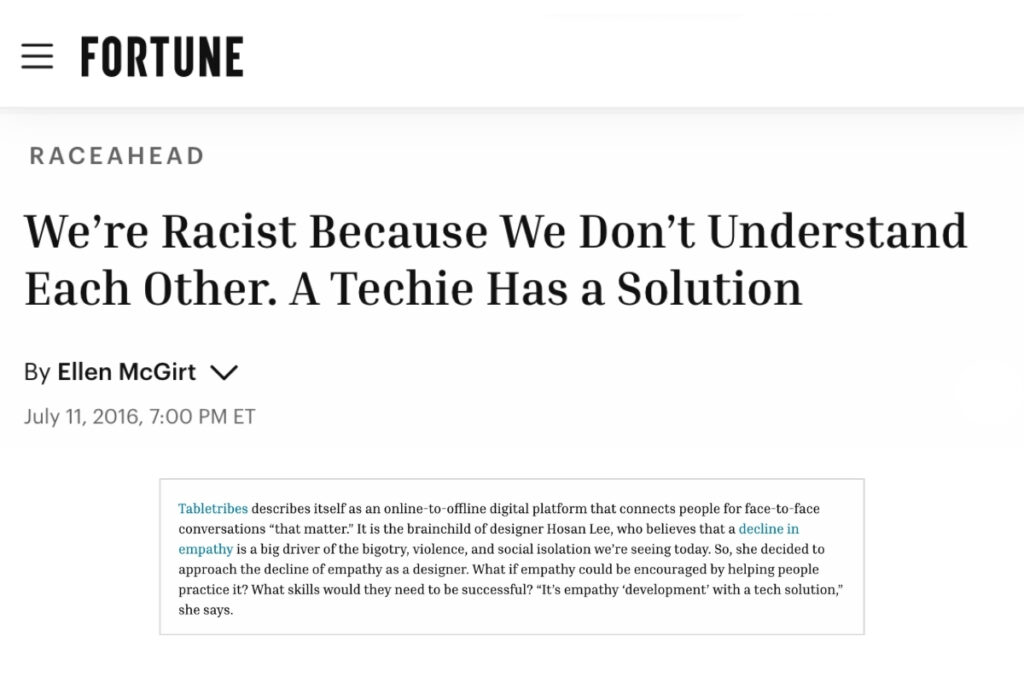
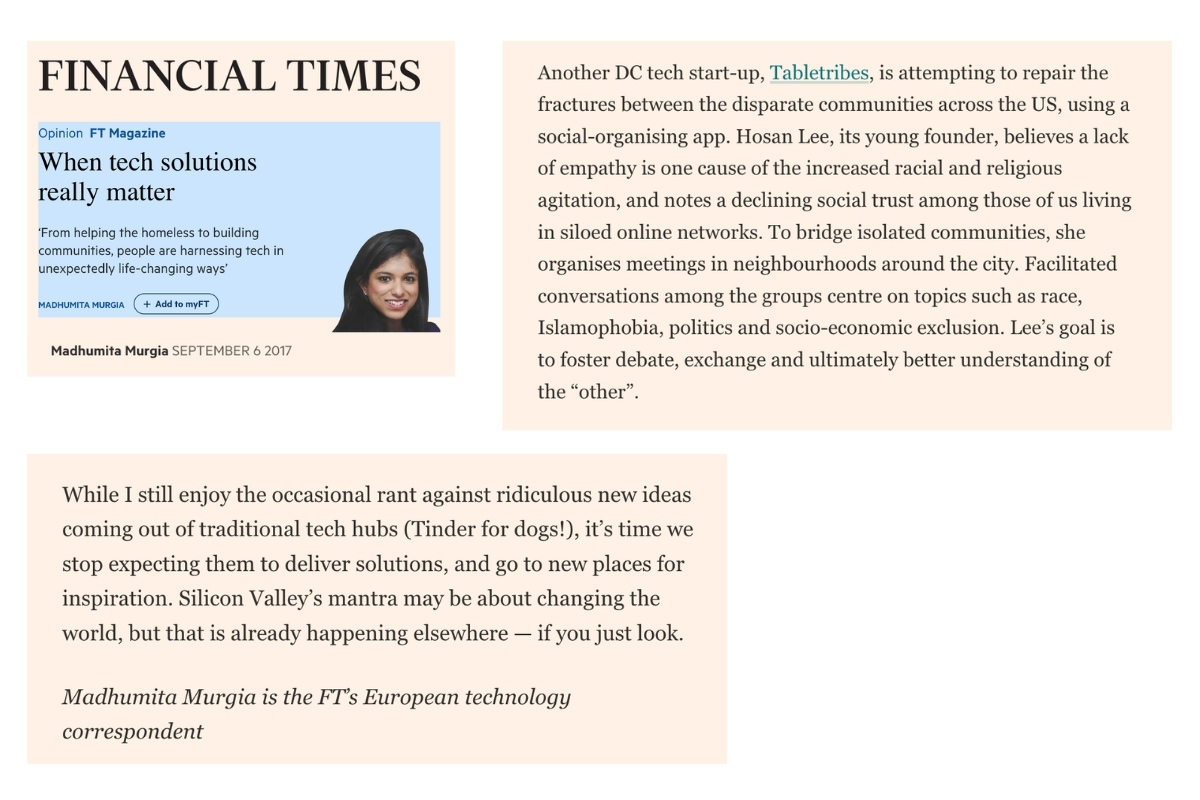
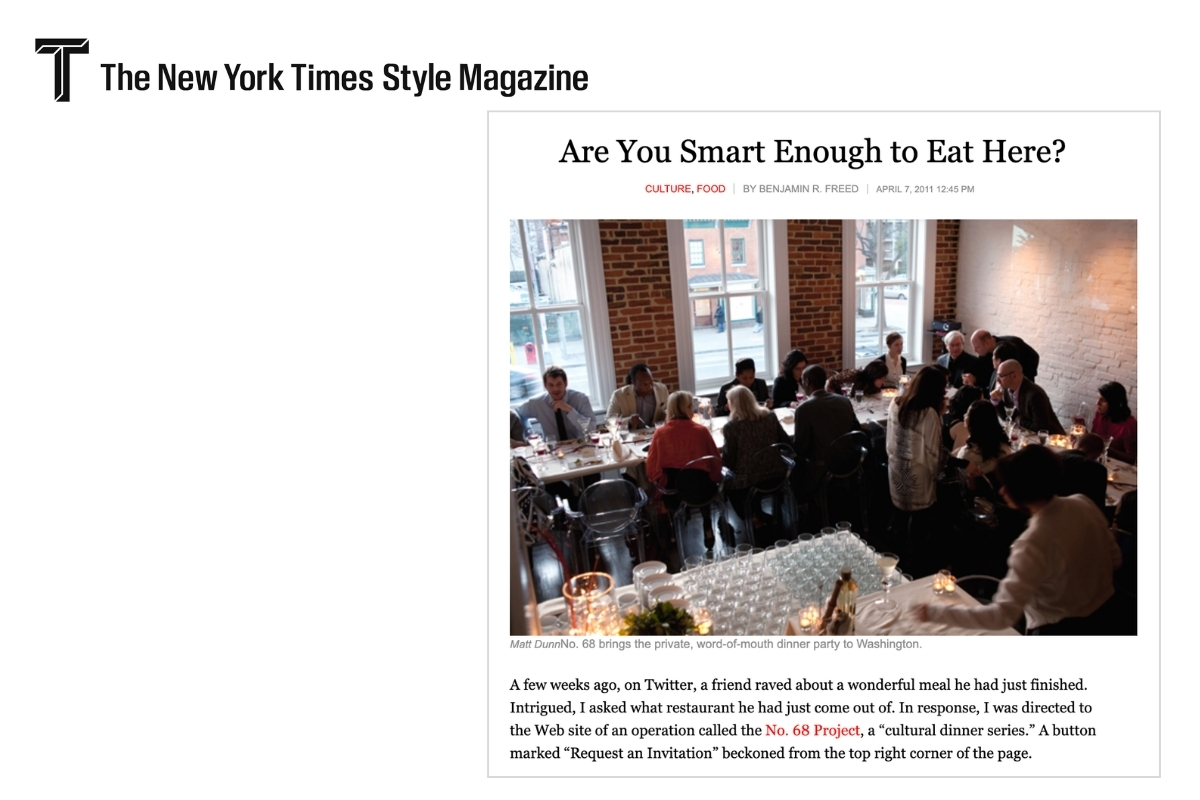
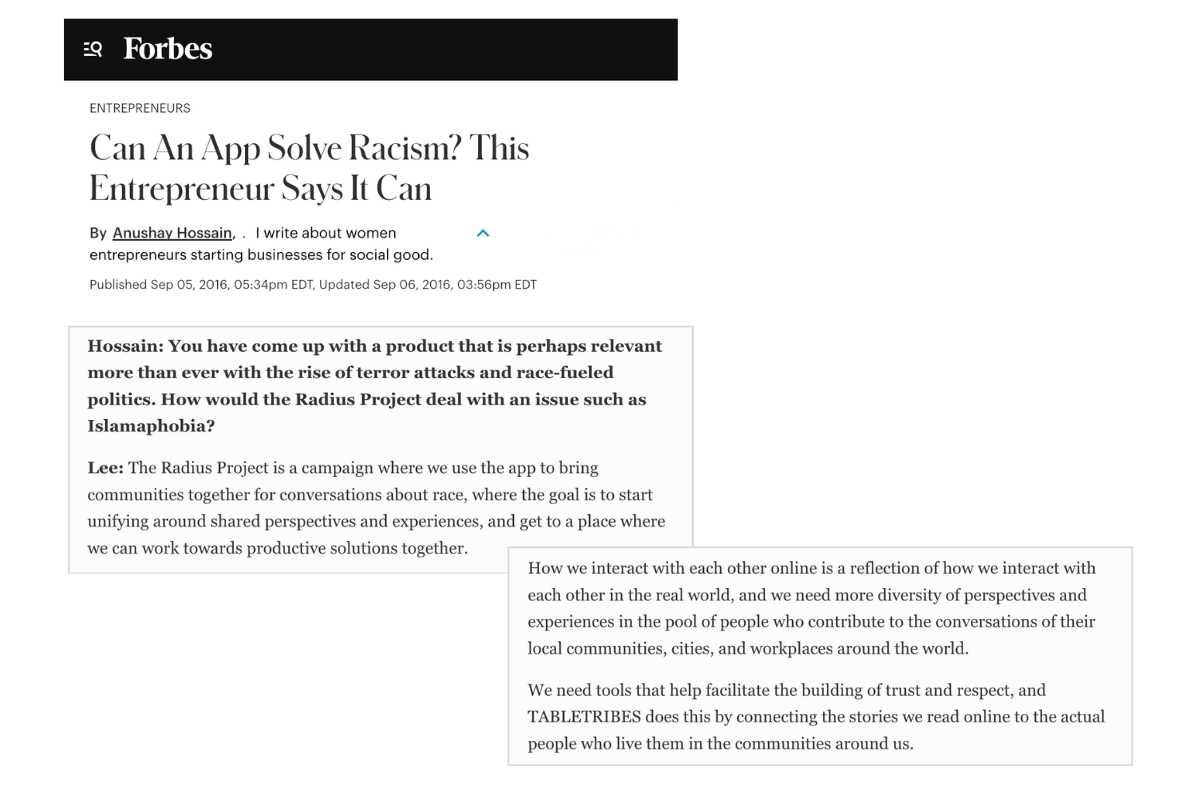
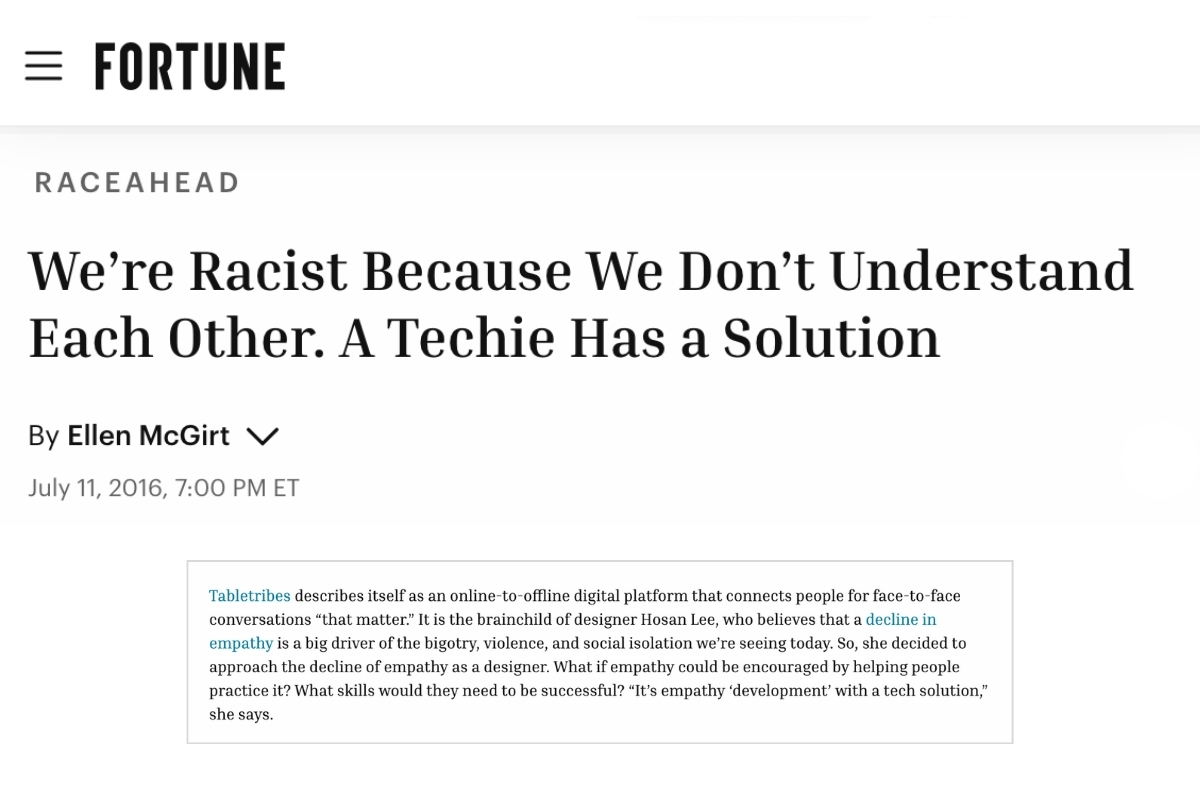
MAJOR PRESS
New York Times
Forbes
Fortune
Financial Times
Washington Post
New York Times
Forbes
Fortune
Financial Times
Washington Post
Documented methodology includes engagement protocols, conversation design templates, and a licensing framework. Culminated in a Civic Hall accelerator residency in NYC.
By 2011, multiple signs pointed to the erosion of social connection: declining third places, shrinking institutional membership, social platforms producing isolation alongside connectivity, geographic mobility disrupting family proximity, networking producing contacts but not relationships.
The central inquiry was articulated in the 2014 Wisdom Hackers essay: “How do we create a global network of sustainable empathy?”
Key insight that led to the founding of TABLETRIBES in order to put research into practice: empathy and connection – foundational to happiness, health, and collective behavior change – are developable skills, and therefore scalable.
Domain
Signal
Social
Empathy decline (48% over 30 years per Konrath); shrinking discussion networks (down to 2 on average per Brashears); increasing social isolation
Technological
Social media eroding well-being; attention spans diminishing; leisure screen time up, offline socializing down
Economic
Erosion of third places; professionalization of networking; commodification of connection
Environmental
Urban density without community; transitional mobility in cities
Political
Declining social trust (UK: 60% to under 30%); rising conservative nationalism; civic disengagement
Values
Empathy dismissed as "soft skill"; relationship depth undervalued; productivity prioritized over connection

RETROSPECTIVE ANALYSIS
The methodology was grounded in neuroscience, sociology, and psychology, and applied across 100+ format iterations over six years. Each design decision was a structural intervention that mapped directly to empirical findings about how empathy and trust form between strangers. Retrospective analysis was conducted using Claude and ChatGPT for pattern extraction across six years of documentation.
Design Element
Research Grounding
Function
Fortune Cookie Topics
Spontaneous interaction enables productive bonds
Creates equality, removes pre-planning, lowers entry barriers through playful randomness.
Guest Application
Affective empathy requires vulnerability.
Pre-loads self-disclosure. Participants arrive having already been vulnerable.
Break Down Hierarchies
Empathy and democratic participation are structurally linked.
No keynotes, panels, or designated experts. Enables reciprocal vulnerability.
Event Sequencing
Mirror neurons require co-presence for emotional contagion.
Small → large → small. Builds safety at low stakes before scaling intensity.
Licensing Framework
Social capital is the glue holding institutions together.
Codifies tacit knowledge. Enables replication without founder dependence.
Guest Curation
Isolated individuals evaluate others less generously.
Seeds positive behaviors. Creates modeling for newcomers.
RETROSPECTIVE ANALYSIS (DETAILED)
Click to open
1. Fortune Cookie Topic Selection
Research grounding: “Interaction enables people to build communities… three conditions crucial to building productive bonds: 1) proximity, 2) regular opportunities for spontaneous interactions, and 3) an environment that encourages people to relax.” – Wisdom Hackers, 2014
Design function: The fortune cookie mechanism created spontaneous interaction (randomness removes pre-planning), established equality (no expert selects the topic), and relaxed participants through a playful, familiar object. Selecting topics that “spark conversation among your group” operationalized the insight that empathy activation requires entry points low enough to engage diverse perspectives.
2. Guest Application Process
Research grounding: Research distinction between cognitive empathy (perspective-taking) and affective empathy (feeling with).
Design function: Application questions (“What is your idea of earthly happiness?” / “Who would you invite to your ideal dinner party?”) required self-disclosure before attendance. Guests “revealed humor, passions, secrets, fears… that under normal circumstances might be shared with intimate friends only.” This pre-loaded affective empathy conditions. Participants arrived having already been vulnerable, lowering barriers to authentic connection during the event.
3. “Break Down Hierarchies” Principle
Research grounding: “Empathy – the driving force behind communication and productive relationship building – is also the soul of democracy… The more empathetic the culture, the more democratic its values.” – Wisdom Hackers, 2014 (drawing on Jeremy Rifkin)
Design function: Explicit prohibition of keynotes, panel discussions, podiums, PowerPoints, and “designated hierarchy of subject matter expert vs guest” operationalized the insight that empathy and democratic participation are structurally linked. Hierarchical formats inhibit reciprocal vulnerability.
4. Event Sequencing (Small → Large → Small)
Research grounding: “Face-to-face engagement is crucial” for empathy activation; mirror neurons create automatic emotional contagion “we automatically and physically feel what other people feel.”
Design function: Program flow (arrival/mingling → large group discussion → break into smaller groups → close) managed emotional intensity. Initial small-group interaction built safety and activated mirror neuron systems at low stakes. Large-group discussion leveraged accumulated emotional resonance. Return to small groups allowed processing and relationship consolidation.
5. Licensing Framework (TT Picnic Manual)
Research grounding: “Social capital is not just the sum of the institutions that underpin a society – it is the glue that holds them together” and the need for “day-to-day solutions for creating these bonds.”
Design function: The 16-page manual codified tacit knowledge, transforming successful empathy conditions into replicable infrastructure. The 7-week timeline, collaborator roles, and checklists enabled communities to generate empathy activation without depending on original founders. This addressed the sustainability issue of how empathy networks could persist without constant external intervention.
6. Guest Curation (40% Hand-Picked)
Research grounding: “Socially isolated… individuals evaluate others less generously” and “lonely people are more likely to take advantage of others’ trust.”
Design function: Recommending organizers “carefully hand-pick at least 40% of your audience” functioned as quality control for empathy conditions. Introducing participants who model vulnerability, curiosity, and generosity created behavioral scaffolding for newcomers. The feedback loop concept (problems → symptoms → decline → more problems) implies the reverse: seeding positive behaviors → modeling → adoption → reinforcement.
REFLECTION
This methodology directly informed the Oxford Street Civic Engagement Platform, where collective efficacy theory extended the approach to building social infrastructure among urban transient populations cycling every 1–3 years.
Aging populations face compounding trust barriers: unfamiliar products, unfamiliar technologies, and loss of the social networks that typically mediate adoption. The same conditions that enable strangers to form trust with each other – structured contact, low-stakes entry, reciprocal vulnerability – may apply to how older adults come to trust new products and services, including emerging technologies like AI.
WHAT TRANSFERRED
- Community First: Community is a precondition for behavior change, not a byproduct of it.
- Designable Systems: Community can be systematically designed with consistent, replicable frameworks.
- Identity and Trust Barriers: The hardest adoption barriers are identity and trust, not information or access.
- Infrastructure Needs Models: Engagement infrastructure requires institutional support or aligned business models to sustain. Financial sustainability is as important as social impact. Mission without model doesn’t survive.

OPEN QUESTIONS
- Digital-First Adaptation: How might the methodology adapt for digital-first contexts post-pandemic?
- Institutional Structures: What institutional structures best support sustained social infrastructure work?
- Cultural Translation: How do facilitated stranger interactions translate across cultural contexts?
- Commercial Sustainability: What role does commercial sustainability play in social innovation longevity?
- Zero-Tie Populations: Can structured social infrastructure accelerate community formation where no pre-existing ties exist?
ARTEFACTS
METHODS + SKILLS
Click to open
Research → Strategy → Action
Facilitation and engagement design
- Facilitation design and delivery (300+ sessions across five cities; groups of 10–200)
- Conversation design methodology (infrastructure for many-to-many dialogue)
- Workshop methodology development (format design, participant curation, conversation architecture)
Research and analysis
- Trend analysis and weak signal identification
- Cross-sector pattern recognition
- Theoretical grounding and literature synthesis
- Retrospective foresight analysis (Three Horizons, backcasting, AI-assisted framework extraction)
Design and development
- Rapid prototyping and iterative testing (100+ format variations)
- Design research and engagement design
- Product development (user flows, wireframes, functional prototype)
Operational
- Methodology codification and knowledge transfer
- Multi-city operations
- Press and communications
SOURCES
Click to open
- Brashears, M.E. (2011) ‘Small networks and high isolation? A reexamination of American discussion networks’, Social Networks, 33(4), pp. 331-341.
- Brown, B. (2012) Daring Greatly: How the Courage to Be Vulnerable Transforms the Way We Live, Love, Parent, and Lead. New York: Gotham Books.
- Cigna (2018) Cigna U.S. Loneliness Index. Bloomfield, CT: Cigna.
- Damasio, A. (1994) Descartes’ Error: Emotion, Reason, and the Human Brain. New York: Putnam.
- de Waal, F. (2009) The Age of Empathy: Nature’s Lessons for a Kinder Society. New York: Harmony Books.
- Goleman, D. (2006) Social Intelligence: The New Science of Human Relationships. New York: Bantam Books.
- Granovetter, M.S. (1973) ‘The strength of weak ties’, American Journal of Sociology, 78(6), pp. 1360-1380.
- Konrath, S.H., O’Brien, E.H. and Hsing, C. (2011) ‘Changes in dispositional empathy in American college students over time: A meta-analysis’, Personality and Social Psychology Review, 15(2), pp. 180-198.
- Lieberman, M.D. (2013) Social: Why Our Brains Are Wired to Connect. New York: Crown Publishers.
- Murthy, V . (2017) ‘Work and the Loneliness Epidemic’, Harvard Business Review, September 2017.
- Putnam, R.D. (2000) Bowling Alone: The Collapse and Revival of American Community. New York: Simon & Schuster.
- Rifkin, J. (2009) The Empathic Civilization: The Race to Global Consciousness in a World in Crisis. New York: Jeremy P. Tarcher/Penguin.
- Seligman, M.E.P. (2011) Flourish: A Visionary New Understanding of Happiness and Well-being. New York: Free Press.
- Turkle, S. (2011) Alone Together: Why We Expect More from Technology and Less from Each Other. New York: Basic Books.